Rethinking the Digital Classroom: Why Our Youngest Learners Need Paper, Not Pixels
Have we been sold a false promise about education: that every child needs a device, and the earlier the better? School districts across the country have rushed to embrace 1:1 programs, placing laptops and tablets in the hands of kindergarteners alongside their crayons and pencils. But what if, in our eagerness to prepare children for a digital future, we’re actually undermining the very foundation they need to succeed?
Is it time to press pause on the pixels and reconsider what our youngest learners truly need? Are 1:1 devices in early elementary school doing more harm than good?
The Pen Is Still Mightier Than the Keyboard
Let’s start with what happens in a child’s brain when they pick up a pencil versus when they tap on a keyboard. The difference isn’t subtle. It’s neurological.
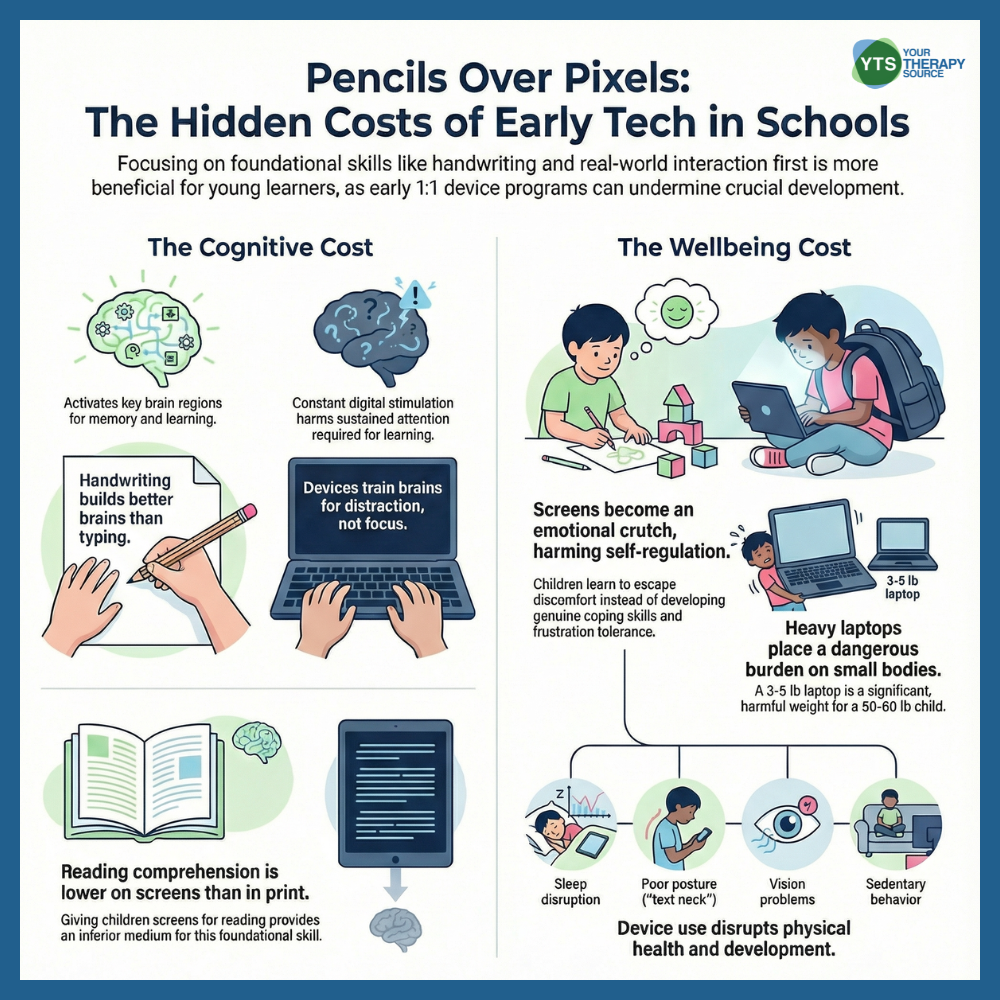
Research shows that handwriting stimulates widespread, synchronized brain activity across regions critical for memory and learning. These neural patterns simply don’t appear during typing. When children write by hand, their brains light up in ways that build the very architecture needed for complex thinking and retention.
The impact on literacy development is profound. When young children learn to form letters by hand, they’re doing far more than creating symbols on paper. They’re building the neural pathways that support reading. The motor memory of writing an “a” helps a child recognize an “a” when they see it on a page. This connection between hand and eye is fundamental to early literacy, and it’s largely absent when children type on keyboards where every letter requires the same pressing motion.
Written expression suffers as well when children keyboard too early. Handwriting’s slower pace isn’t a bug. It’s a feature. When children write by hand, they must think before they write, mentally composing and organizing their thoughts. The physical effort of forming each letter, each word, creates a natural pause for reflection. They learn to be deliberate with language, to choose words carefully, to structure sentences with intention.
Keyboarding, especially for young children still developing fine motor skills and literacy foundations, often becomes a mechanical hunt-and-peck exercise. Their cognitive energy goes into finding the right keys rather than crafting meaningful sentences. They may produce more words, but not better writing. Quantity replaces quality. The thoughtful composition that handwriting encourages (the mental drafting, the consideration of word choice, the awareness of sentence structure) gets lost in the mechanics of typing.
Even reading itself suffers on screens. Study after study confirms that reading comprehension is consistently lower on digital displays than in print. For young learners still building foundational literacy skills, this gap is particularly concerning. We’re asking children to develop as readers while giving them an inferior medium for the task.
The Attention Crisis We’re Creating
Walk into any classroom with 1:1 devices and ask the teachers what they’re observing. You’ll hear a consistent refrain: students struggle to maintain attention. Entertainment media and constant digital stimulation are reshaping how children focus, or fail to.
Children’s brains are being trained to expect instant stimuli, constant interaction, rapid-fire feedback. Then we ask them to sit still and listen to a teacher. To lose themselves in a chapter book. To think deeply about a single problem. We’ve set them up to fail at the very skills education requires.
The myth of multitasking makes this worse. Students who multitask with technology experience significant cognitive losses, and the distraction spreads to those around them. The student trying to focus while classmates toggle between tabs and apps faces an uphill battle.
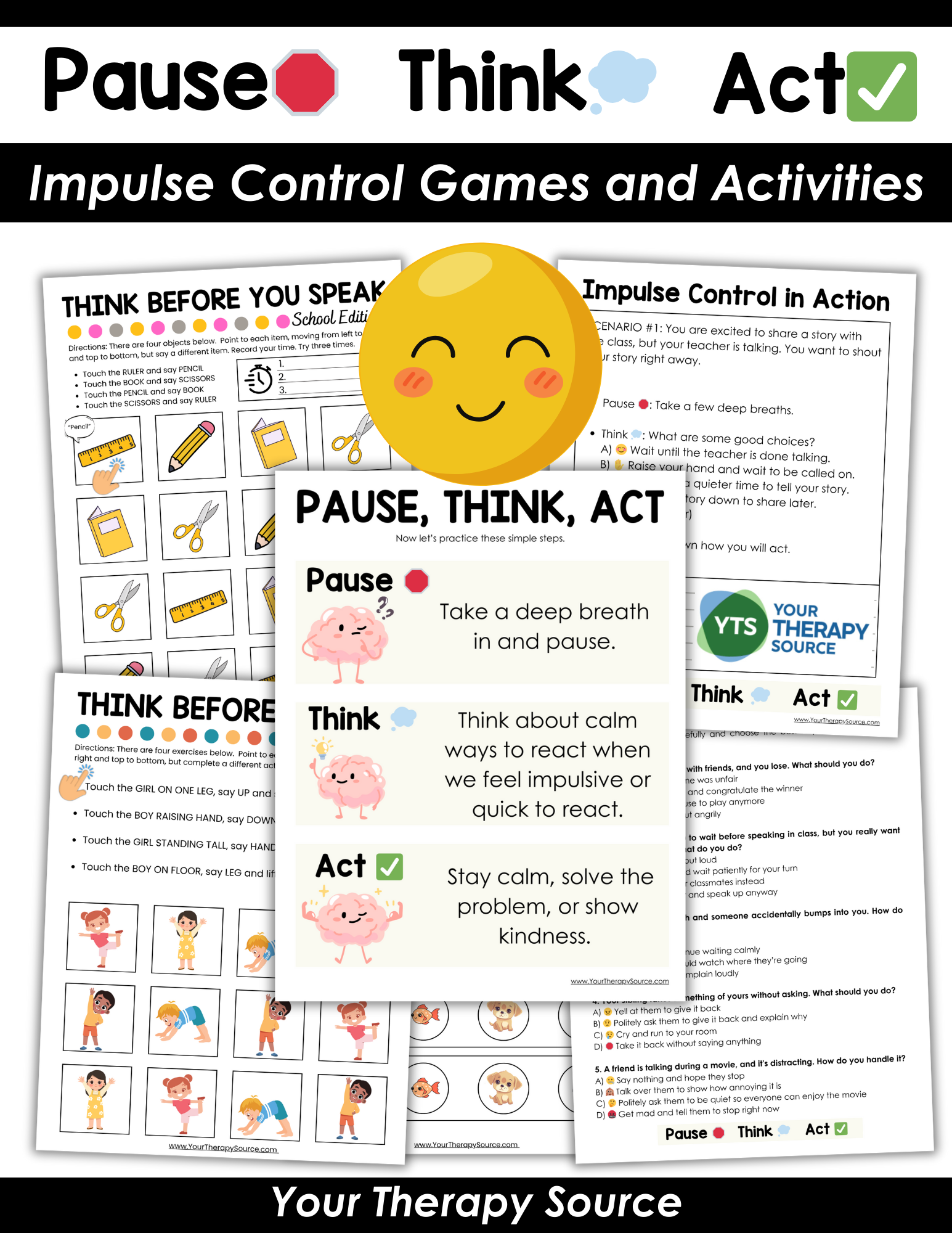
Impulse Control Workbook – Pause, Think, Act
Develop lifelong skills for self-regulation and thoughtful decision-making!
The Crisis in Self-Regulation and Mental Health
Perhaps the most insidious effect of early device dependence is what it does to a child’s developing ability to regulate their emotions and behavior.
Young children are in a critical period for learning self-regulation: how to manage frustration, delay gratification, cope with boredom, and process difficult emotions. These skills don’t develop automatically. They require practice, guidance from caring adults, and most importantly, the experience of sitting with uncomfortable feelings and working through them.
But when a device is always within reach, it becomes an emotional crutch. Bored? There’s a game for that. Frustrated with a challenging task? Switch to something easier on the screen. Feeling anxious or sad? Escape into a video. The screen offers instant relief, instant distraction, instant gratification. And in doing so, it short-circuits the very neural pathways children need to develop genuine coping skills.
The dopamine hits from games, apps, and digital rewards create a cycle that undermines a child’s natural ability to find satisfaction in slower, quieter activities. They’re learning that discomfort should be immediately escaped rather than managed. That waiting is intolerable. That entertainment should be constant.
Teachers and counselors are seeing the results: children who melt down when devices are taken away, who can’t tolerate even brief periods of boredom, who struggle to work through challenges without immediate digital reinforcement. We’re seeing anxiety and depression rates climb among younger and younger children. While screens aren’t the only factor, they’re a significant one, particularly when introduced before children have developed the emotional toolkit to use them in healthy ways.
Social-emotional learning (the ability to understand and manage emotions, show empathy, establish positive relationships, and make responsible decisions) happens primarily through human interaction. It requires reading facial expressions, navigating conflicts with peers, receiving comfort from a teacher, and learning to be present with others. Every hour spent staring at a screen is an hour not spent developing these irreplaceable human skills.
Children need to learn that they can survive, and even thrive, without constant digital stimulation. They need to discover their own inner resources for managing emotions and entertaining themselves. They need to build frustration tolerance by working through difficult problems without the escape hatch of a screen. These are not optional skills. They are fundamental to mental health and long-term wellbeing.
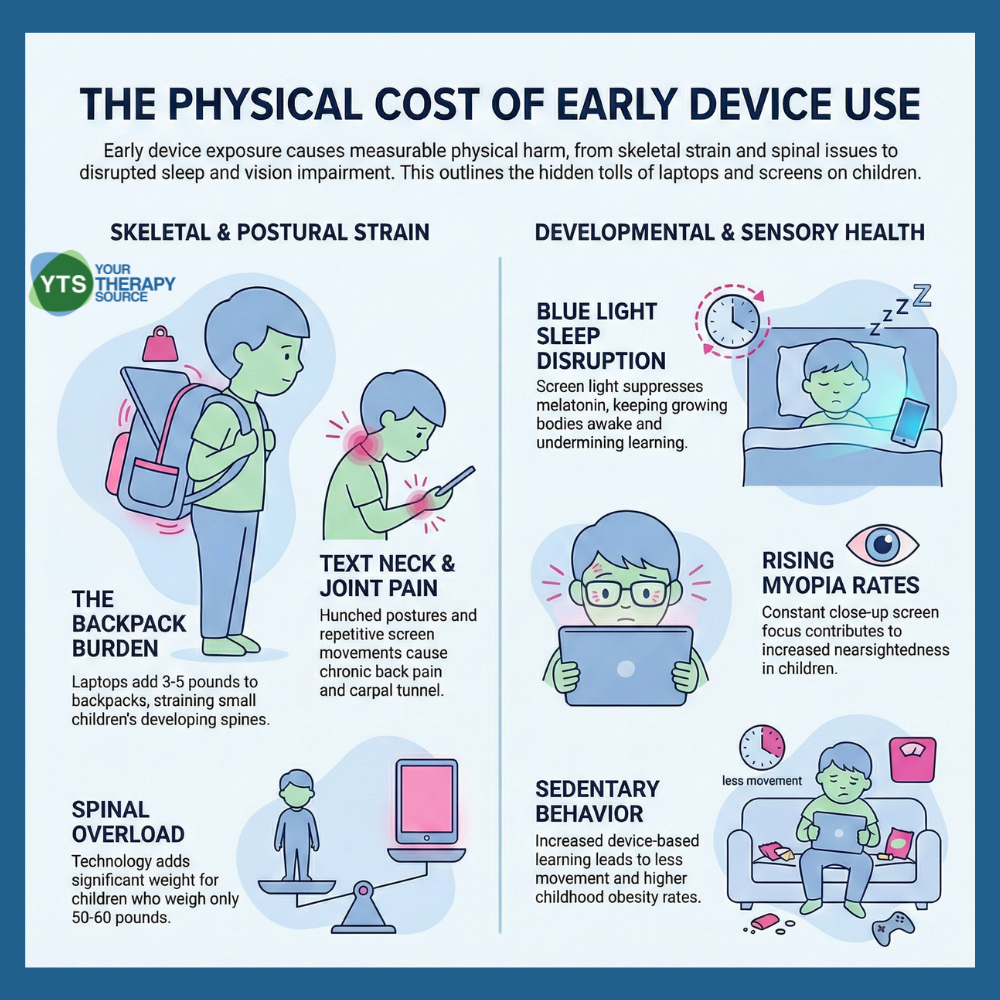
The Physical Toll on Growing Bodies
The health impacts of premature device saturation are alarming and underreported.
Sleep Disruption: Children are significantly more sensitive to blue light than adults. Evening screen exposure (which 1:1 programs inevitably encourage through homework and extended use) disrupts their natural sleep patterns. Blue light suppresses melatonin production, leading to later bedtimes and worse sleep quality. We’re literally keeping kids awake when their growing bodies desperately need rest, directly undermining their ability to learn and develop.
Musculoskeletal Problems: Pediatricians are seeing a surge in “text neck,” that telltale hunched posture from staring down at screens. Young children are developing chronic back pain and carpal tunnel syndrome from repetitive movements. These aren’t conditions we should be normalizing in elementary school.
The Backpack Burden: Here’s a problem hiding in plain sight. We’re requiring young children to carry laptops to and from school every day. A typical laptop weighs 3-5 pounds, often in a bulky protective case. For a first or second grader weighing 50-60 pounds, that’s a significant portion of their body weight added to already-heavy backpacks stuffed with books and supplies. Orthopedic specialists have long warned about backpack weight straining developing spines. Now we’ve added several pounds of technology to the load, asking six-year-olds to lug devices back and forth daily, contributing to poor posture and potential long-term spinal issues. Many of these children can barely zip their own coats, but we expect them to safely transport expensive, fragile equipment.
Vision Problems: Eye doctors are reporting increases in myopia (nearsightedness) among children, with screen time as a major contributing factor. Eyes that should be developing while looking at varied distances are instead locked on screens inches from their faces for hours each day.
Sedentary Behavior: Device-based learning means more sitting, less moving. Childhood obesity rates continue to climb, and increased screen time (both at school and at home) plays a significant role.
We’re asking children’s developing bodies to pay a steep price for technology they don’t yet need.

Growing the Foundation First
Think of child development like growing a tree. You can’t rush the roots by adding technology to the branches. A young sapling needs time to develop a deep, extensive root system before it can support heavy limbs and bear fruit. Try to load the branches too early, and you risk stunting the very growth you’re trying to encourage.
This isn’t just metaphor. It’s how the brain actually develops. A child’s brain grows through the formation of neural pathways, like tiny branches reaching out to make connections. Every time a child practices a skill, whether it’s forming letters by hand, working through frustration, or reading someone’s facial expression, the brain creates and strengthens these pathways. The more a pathway is used, the stronger it becomes. The pathways that aren’t used get pruned away.
This is where early device dependence becomes particularly harmful. When screens do the heavy lifting for children (providing instant answers, immediate entertainment, constant stimulation), the neural pathways for patience, deep thinking, and self-regulation never get the repeated practice they need to grow strong. Meanwhile, the pathways for seeking instant gratification and external stimulation get reinforced over and over. The brain is literally being wired differently, prioritizing the branches we don’t want at the expense of the ones we do.
The roots our children need (handwriting fluency, sustained attention, physical coordination, face-to-face social skills, emotional regulation, and the ability to think deeply without constant stimulation) must grow strong and deep first. These aren’t quaint throwbacks to a bygone era. They’re the foundation that will support everything that comes later. Without them, children may appear to flourish on the surface while remaining fundamentally unstable.
The good news? Technological literacy is a skill that can be mastered remarkably quickly once a child has the developmental maturity to use devices as tools rather than crutches. Students in upper elementary can learn what they need to know about using technology in a matter of weeks or months. But you cannot teach a middle schooler how to focus, how to process information deeply, how to manage their emotions without screens, or how to develop empathy if those crucial windows have closed. Some roots can only grow during certain seasons. Some neural pathways, once pruned, cannot be regrown.
During these early formative years, we should protect the space children need to develop. Let them move their bodies, work with their hands, look each other in the eye, and connect with the physical world. The digital world will still be there, waiting, when they’re ready to engage with it meaningfully.
Our youngest learners don’t need pixels. They need paper, pencils, and the time to grow into the humans they’re meant to become.
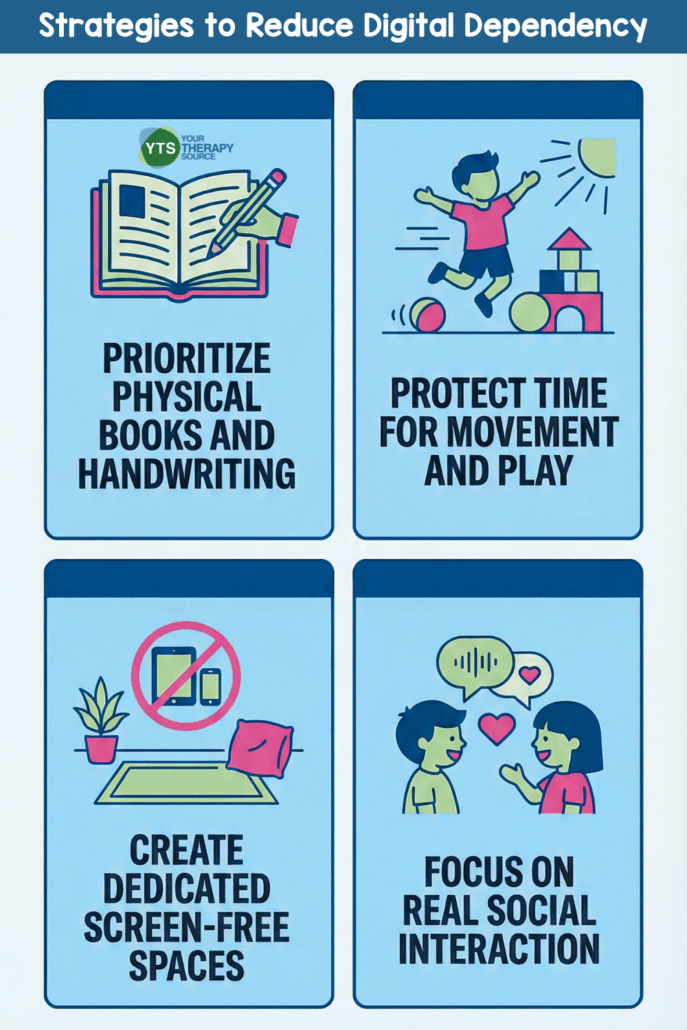
10 Ways Educators Can Protect Early Learners from Premature Screen Dependence
Teachers know firsthand what’s happening in classrooms. Many of you are already sounding the alarm about shortened attention spans, declining handwriting skills, and students who struggle without constant digital stimulation. You didn’t create this problem. In many cases, you’ve inherited district mandates and administrative expectations that prioritize technology adoption over developmental readiness.
But educators also have unique insight into what children need, and your voices matter. Here are strategies teachers have used to protect early learners within the constraints of existing systems:
1. Be Intentional About When Screens Are Truly Necessary
Just because devices are available doesn’t mean they need to be used constantly. Many teachers have found success by asking themselves: “Does this task genuinely require technology, or would it be equally or more effective without it?” Writing a story, practicing math facts, reading a book, or working through a science observation often don’t need screens at all. When you make thoughtful choices about when technology adds value versus when it’s just the default, you’re using your professional judgment to serve students’ developmental needs.
2. Reclaim Time for Handwriting Instruction
Even in schools with 1:1 programs, you control how you structure instructional time. Many teachers have successfully maintained daily handwriting practice by framing it as essential literacy instruction. When students write by hand for journals, notes, or drafts, you’re not being old-fashioned. You’re supporting brain development. You know this matters, even when others question it.
3. Keep Physical Books Central to Your Classroom
Your classroom library is one of the most powerful tools you have. Fill it with books students want to read, create inviting spaces to enjoy them, and make library visits a cherished routine. When you can, choose printed texts over digital ones for read-alouds and independent reading. You’re not resisting progress. You’re choosing the medium that best supports young readers.
4. Protect Time for Movement and Play
You see what happens when children sit too long: the fidgeting, the wandering attention, the frustration. You already know movement isn’t a luxury; it’s a necessity. Build in brain breaks, maximize outdoor time, use hands-on materials, and advocate fiercely for recess. When administrators push back, you have the data: young bodies and brains need movement to learn.
5. Establish Screen-Free Spaces in Your Day
Even if your school requires device use, you likely have some autonomy over when they’re open and closed. Many teachers have found success creating device-free zones: screens stay closed during morning meeting, lunch, recess, and certain subjects. These boundaries aren’t about rejecting technology. They’re about protecting the time children need for human connection and focus.
6. Make Space for Boredom and Self-Discovery
You’ve probably noticed that students panic when they finish work early and have nothing to do. The impulse to immediately give them a device is understandable, but you have alternatives. Stock your room with open-ended materials: books, art supplies, puzzles, building materials. Let children discover that they can entertain themselves. These moments of productive boredom are becoming rare, and you can preserve them.
7. Prioritize Real Social Interaction
You witness daily what happens when children don’t get enough practice with face-to-face communication. You’re already facilitating partner talks, group work, and conflict resolution, and you know how essential these are. When you protect time for students to work through disagreements, read each other’s emotions, and collaborate without screens mediating every interaction, you’re teaching skills technology cannot.
8. Partner With Parents as Allies
Many parents share your concerns but feel pressured by school expectations or don’t realize there’s an alternative. When you communicate about why you’re limiting screens or requiring handwriting, you’re not criticizing them. You’re giving them permission to prioritize developmental needs at home too. Share what you’re seeing in the classroom. Most parents will be grateful for your honesty and leadership.
9. Trust Your Low-Tech Teaching Expertise
You became a teacher to work with children, not to manage devices. Your most effective tools have always been your voice, your creativity, your ability to spark curiosity and guide discovery. When you teach without screens (using discussions, demonstrations, hands-on exploration, and storytelling), you’re not behind the times. You’re doing what you’ve always known works best.
10. Share What You’re Seeing With Others
Your observations matter. When you notice improvements after reducing screen time, document them. When you see students struggling with device dependence, talk about it with colleagues. Write about it. Share it at staff meetings or parent nights. Your experience in the classroom gives you valuable perspective that can inform better practices and decisions about technology use with young learners.
Childhood is fleeting, and these early years are precious. Young learners need to feel the texture of paper under their pencils, hear the rustle of turning pages, look into the eyes of their classmates during a disagreement, and discover what their bodies can do when they’re allowed to move freely. They need to build with blocks, mix paint colors, plant seeds and watch them grow, get their hands dirty, and learn that they can create something meaningful without a screen lighting the way. These aren’t nostalgic luxuries. They’re the real-life experiences that build the neural connections, physical capabilities, and emotional resilience children will carry with them for a lifetime. When you create space for these experiences in your classroom and at home, you’re giving children something irreplaceable: the chance to be fully present in their own growing up.