
5 Ways to Strengthen MTSS Using What You Already Have
MTSS (Multi-Tiered System of Supports) often feels like one more initiative piled onto an already overwhelming workload. There’s pressure to implement new programs, collect more data, attend more meetings, and somehow coordinate interventions across multiple tiers all while maintaining your existing caseload and responsibilities. But here’s what often gets missed: you probably already have many of the pieces of an effective MTSS framework. Learn how to strengthen MTSS using what you already have.
The problem isn’t usually a lack of resources. It’s that what you have is scattered, inconsistent, or not being used strategically. What transforms MTSS from overwhelming to manageable is having clear processes that help teams move from “we’re concerned about this student” to “here’s a specific plan with matched supports” quickly and confidently. Here are five ways to strengthen your MTSS structure by organizing and leveraging what’s already in place.
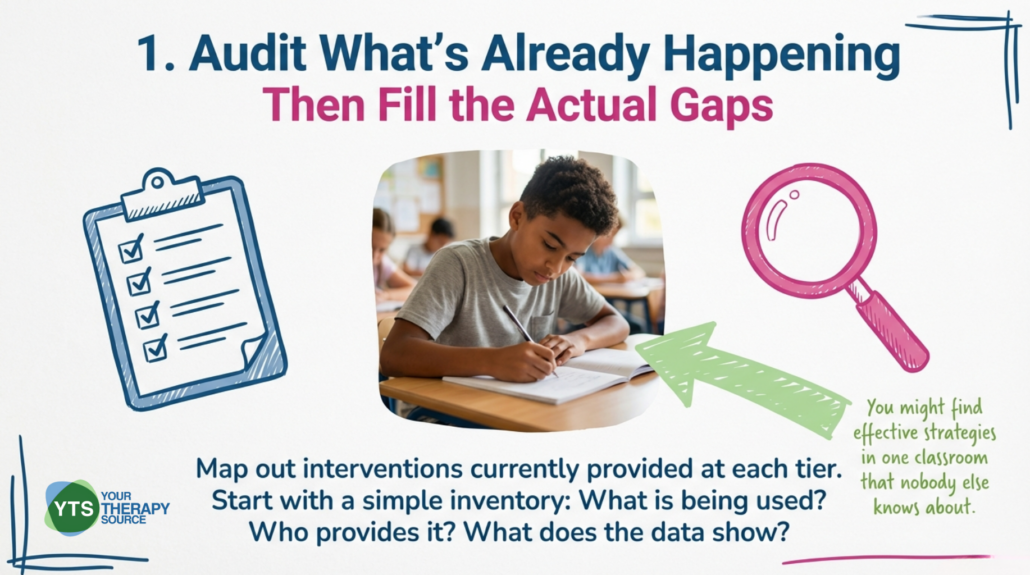
Audit What’s Already Happening, Then Fill the Actual Gaps
Before adding anything new, map out what interventions and supports are currently being provided at each tier across your school. You might be surprised to discover:
- Three different teachers using three different reading interventions for similar student needs
- Tier 2 supports that are actually more intensive than some Tier 3 services
- Effective strategies being used in one classroom that nobody else knows about
- Students receiving multiple overlapping interventions without coordination
Start with a simple inventory: What interventions are being used? Who’s providing them? How often? For which students? What does the data show about their effectiveness?
Once you can see the full picture, you can identify the real gaps. Maybe you don’t need a new social-emotional curriculum. You need to implement the one you have with consistency. Maybe you don’t need more Tier 2 reading support. You need to strengthen Tier 1 core instruction so fewer students need intervention in the first place.
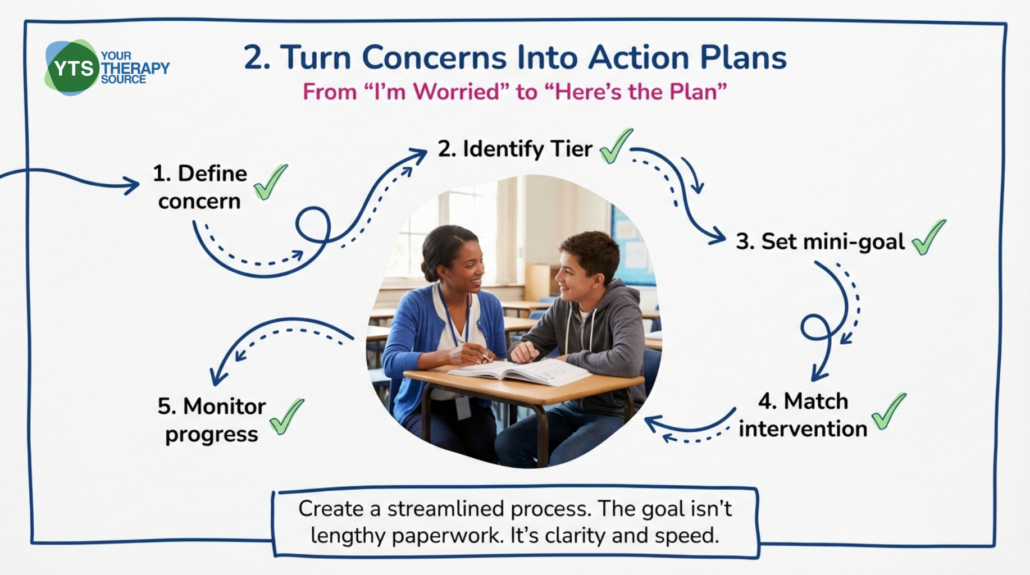
Turn Student Concerns Into Clear, Tiered Action Plans
One of the biggest MTSS breakdowns happens in the translation from concern to action. A teacher says “I’m worried about Marcus,” and then… what? Without a clear process, that concern either sits unaddressed or jumps straight to a special education referral because no one knows what else to do.
Create a streamlined process that helps teams:
- Define the specific concern in measurable terms
- Identify what tier of support is appropriate
- Generate a focused mini-goal
- Match interventions to that goal across Tier 1, 2, and 3
- Establish simple progress monitoring
When teams have a framework that guides them from concern to concrete plan, they’re more likely to intervene early and appropriately. The goal isn’t lengthy paperwork. It’s clarity and speed. What’s the concern? What’s the plan? How will we know if it’s working?
Having this kind of structured approach means teachers don’t have to figure out interventions from scratch, and you don’t have to spend 45 minutes in a meeting brainstorming ideas that may or may not match the student’s actual need.
Make Tier 1 Strategies Visible and Accessible
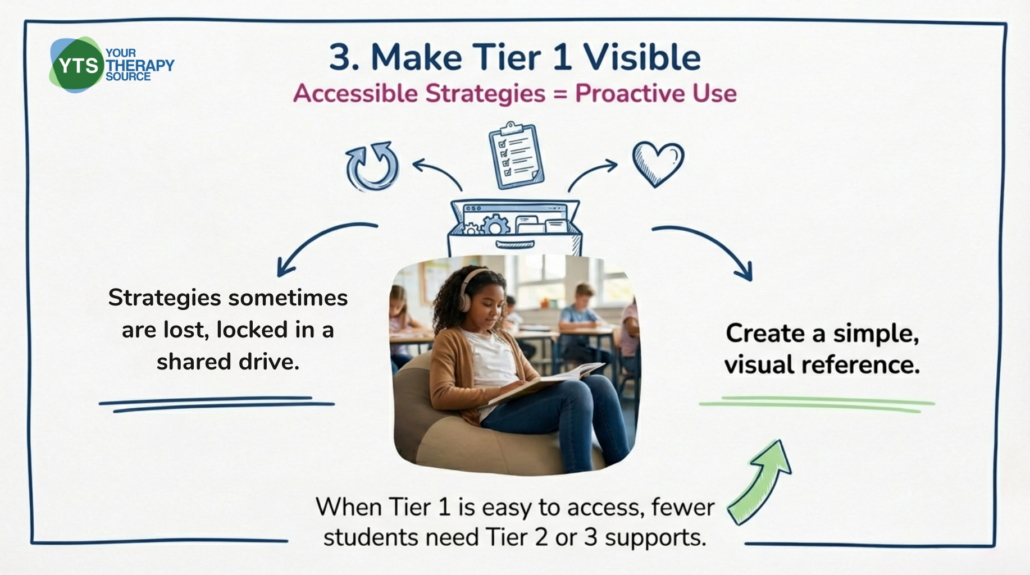
Universal supports (Tier 1) only work if teachers actually know about them and use them. Too often, the strategies that could help many students remain invisible, locked in one provider’s head or buried in a shared drive no one looks at.
Create a simple, visual reference that shows teachers what Tier 1 supports are available:
- Regulation strategies (movement breaks, sensory tools, flexible seating)
- Instructional supports (graphic organizers, visual schedules, modified assignments)
- Social-emotional supports (check-in systems, social narratives, calming spaces)
Make this accessible and practical. Teachers need to see not just what the strategy is, but when to use it and how to implement it. Brief, clear descriptions are far more useful than lengthy documents.
When Tier 1 supports are visible and easy to access, teachers use them proactively. Which means fewer students need Tier 2 or 3 supports in the first place. This is how you strengthen MTSS without adding to your caseload.
Repurpose Existing Meetings for Focused Problem Solving
Most schools already have team meetings, grade-level meetings, PLCs, or child study teams. The problem is these meetings often lack structure, drift off topic, or focus on compliance rather than problem-solving.
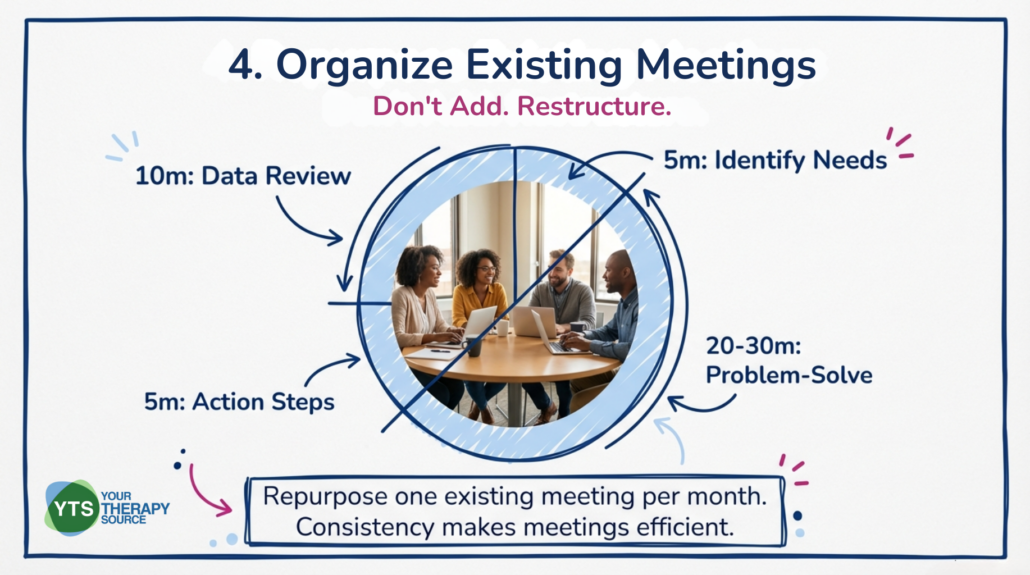
Instead of adding another meeting to the calendar, repurpose one existing meeting per month (or every other week) as a focused MTSS problem-solving session. Use a consistent structure:
- Review universal screening or progress monitoring data (10 minutes)
- Identify 2-3 students who need support adjustments (5 minutes)
- Problem-solve interventions for 1-2 priority students using a protocol (20-30 minutes)
- Assign action steps and set a follow-up date (5 minutes)
The key is consistency. When teams use the same problem-solving process every time, meetings become efficient and productive. Everyone knows what to expect, how to prepare, and what decisions will be made.
You already have the meeting time. You’re just using it more strategically. And that starts with having a clear framework that keeps the team focused on actionable solutions.
Use Simple Data to Drive Tier Movement Decisions
You’re already collecting data: progress monitoring for IEPs, curriculum-based measures, behavior tallies, screening results. The problem is this data often sits in different places and isn’t used systematically to make MTSS decisions.
Create a simple system to review existing data regularly and make tier movement decisions:
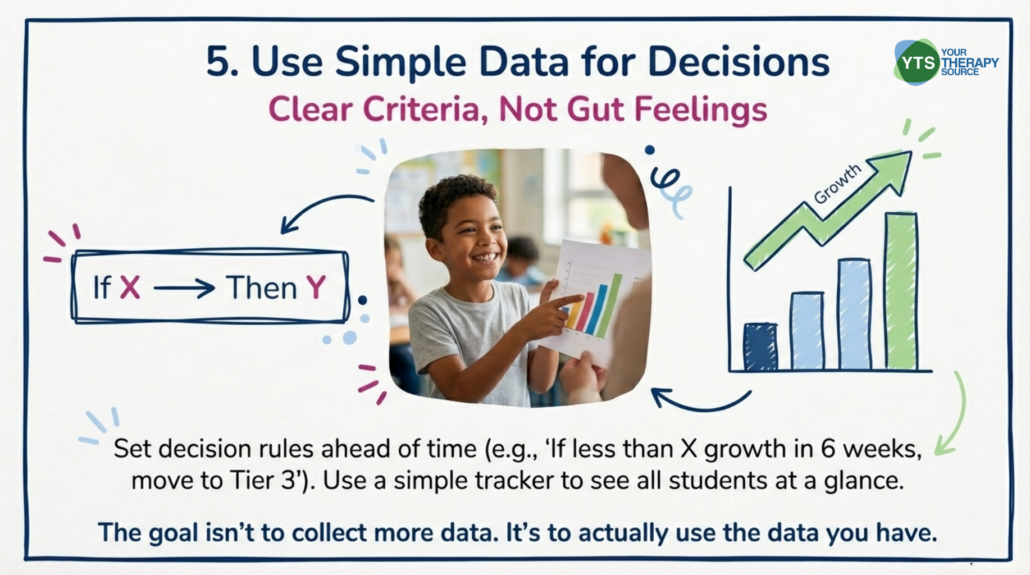
- Set decision rules ahead of time: “If a student makes less than X growth in 6 weeks of Tier 2, move to Tier 3” or “If a student maintains benchmark performance for 8 weeks, fade Tier 2 support”
- Schedule brief data review cycles (every 4-6 weeks) where you look at all students receiving Tier 2 or Tier 3 support
- Use a simple tracker where you can see all students at a glance
- Make decisions as a team based on the data, not based on gut feeling or whoever advocates loudest
The goal isn’t to collect more data. It’s to actually use the data you have to make timely decisions. When you have clear criteria and a regular review cycle, students don’t languish in ineffective interventions, and you don’t waste time on supports that aren’t working.
When data collection is built into your MTSS tools from the start (when the same process that helps you develop the goal also gives you a framework for tracking it), data becomes part of the workflow, not an add-on task.
The Bottom Line
Strengthening MTSS doesn’t require a complete overhaul or a pile of new resources. It requires organization, clarity, and tools that help teams move quickly from concern to action. When you have frameworks that guide problem-solving, generate matched interventions across tiers, and include built-in progress monitoring, MTSS stops feeling like extra work and starts feeling like the way you naturally respond to student needs.
The schools that make MTSS work aren’t necessarily the ones with the most resources. They’re the ones with the clearest processes. When everyone on the team can quickly turn a student concern into a tiered action plan, MTSS becomes a support system for staff, not just a compliance framework. Read more about Making School Based Therapy More Manageable in this series.

