Working Memory and Self Regulation
In elementary classrooms, challenges with impulse control, following directions, and staying focused are often viewed as behavior problems. However, research continues to show that many of these difficulties are closely tied to working memory demands, not a lack of motivation or effort. Recent research took a closer look at working memory and self regulation skills in elementary school students with and without ADHD. The findings provide valuable insight into why some students struggle more as tasks become mentally complex.
Understanding Working Memory and Inhibition at School
Working memory allows students to hold information in mind while using it. Inhibition allows students to stop, wait, or resist acting impulsively.
In elementary school, these skills are required throughout the day, such as:
- Remembering multi-step directions
- Waiting to be called on
- Ignoring distractions during work time
- Pausing before responding or moving
These skills work together. When working memory becomes overloaded, inhibition often breaks down.
What the Research on Working Memory and Self Regulation Found
The study included 80 elementary-aged children between the ages of 7 and 11.
- 40 children had a diagnosis of ADHD
- 40 children were typically developing peers
The two groups were closely matched by age and gender. This allowed researchers to directly compare how increasing working memory demands influenced inhibition performance across groups.
In this study, 80 elementary-aged children (ages 7–11) completed a computerized task that required them to stop a response (inhibition) while also remembering information (working memory). The task began with no working memory demand and gradually became more difficult as additional information had to be held in mind.
Several important patterns emerged:
- When there was no working memory load, children with ADHD and their typically developing peers performed at similar levels.
- As working memory demands increased, children with ADHD showed a steady decline in inhibition performance.
- Under the highest working memory load, children without ADHD actually improved their inhibition, while children with ADHD struggled the most.
- These findings indicate that inhibition difficulties are closely related to how many mental resources are being used at once, rather than a simple lack of self-control.
In practical terms, when a task requires students to hold too much information in mind while also controlling their actions, inhibition is more likely to break down for some learners.
Why This Matters in Elementary Classrooms
Elementary classrooms often place heavy working memory demands on students without realizing it. Students may be expected to:
- Listen to lengthy directions
- Track multiple rules at once
- Manage materials and time
- Monitor their own behavior
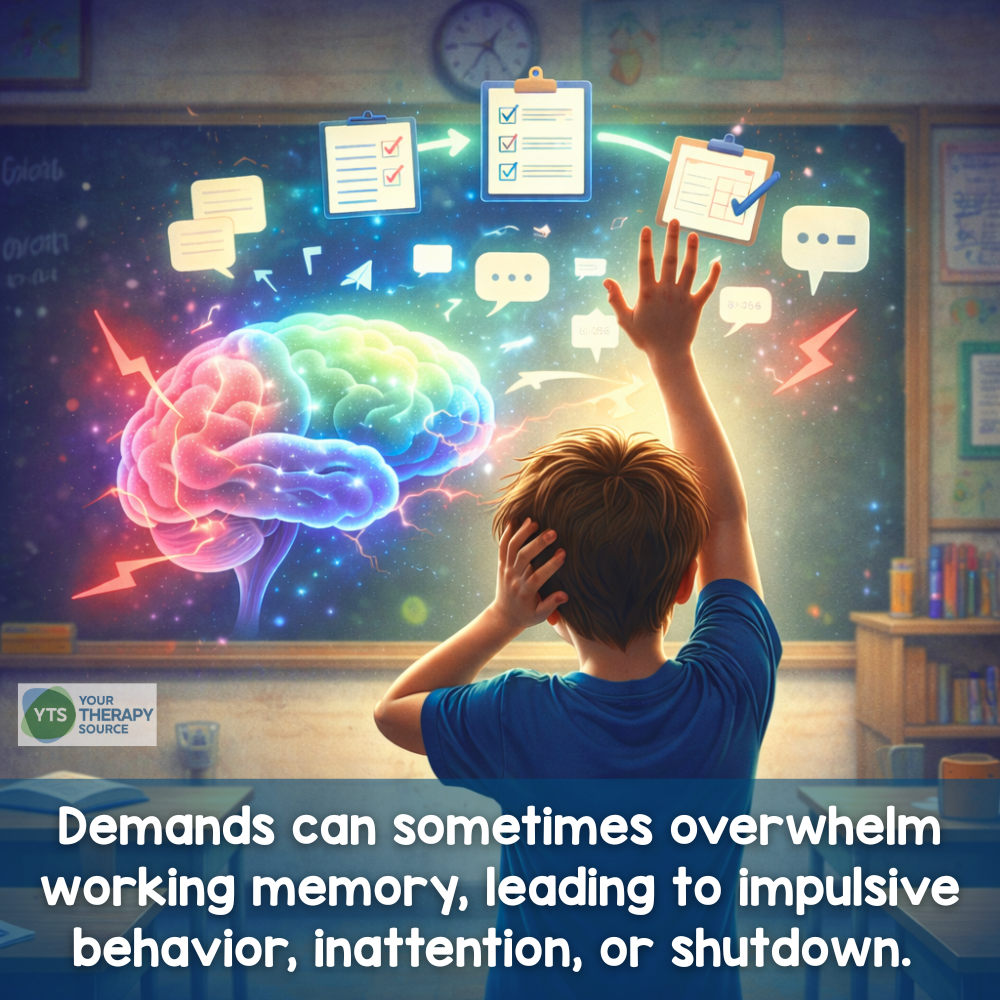
For students with ADHD, these stacked demands can overwhelm working memory, leading to impulsive behavior, inattention, or shutdown. The research supports an important shift in perspective:
Reducing cognitive load can improve self-control.
Practical Strategies to Support Students
Simplify and Chunk Directions
Break instructions into smaller steps and give them one at a time when possible. Fewer pieces of information are easier to hold and act on.
Use Visual Supports
Visual schedules, checklists, anchor charts, and modeled examples reduce reliance on working memory and support follow-through.
Reduce Competing Demands
Limit extra language, visual clutter, and background noise during tasks that require inhibition, such as independent work or transitions.
Build in Processing Time
Pause briefly after giving directions. This allows students time to process before acting and reduces impulsive responding.
Externalize Memory
Encourage students to write steps down, refer to visual cues, or check off tasks rather than relying on internal memory alone.
Coordinate Across the Team
When academic, language, motor, and behavioral demands overlap, collaboration among teachers and related service providers helps prevent overload.
Implications for Related Service Providers
- Occupational therapists can prioritize task simplification and visual supports before targeting impulse control directly.
- Speech-language pathologists can reduce linguistic working memory demands during classroom participation.
- Physical therapists can observe how motor demands interact with attention and inhibition.
- Counselors and psychologists can help teams reframe impulsive behavior as a cognitive load issue rather than defiance.
MORE INFORMATION
For additional support and practical ideas, explore these related resources:
- What Is Working Memory and Hemispheric Integration?
- Drawing and Memory
- Memory Games for the Classroom
- Inhibitory Control
When inhibition breaks down, it is not always a behavior problem. This research shows that working memory overload plays a critical role, especially for students with ADHD. By adjusting task demands, simplifying expectations, and using visual supports, educators and therapists can better support self-control, engagement, and learning in elementary classrooms.
Reference
Orhan, I., & Paralik, I. (2025). Working Memory Load and Inhibition Performance Among Children With ADHD. Journal of Attention Disorders, 10870547251397022.