Motor Development And ADHD In School-Age Children
Understanding how motor development and ADHD are related is important for educators and school-based therapists supporting student participation, learning, and classroom engagement. Motor skills influence how students access instruction, complete academic tasks, and regulate attention throughout the school day. Research increasingly suggests that motor development and attention are interconnected processes that shape functional performance in school settings.
WHAT DID THE RESEARCH SAY ON MOTOR DEVELOPMENT AND ADHD?
The research examined the relationship between motor development and ADHD across infancy, childhood, and adolescence through a critical review of behavioral, longitudinal, and neuroimaging studies. The authors synthesized findings to better understand how early motor skills, later fine and gross motor performance, and motor-related brain systems are associated with attention and executive functioning over time. The review focused on identifying developmental patterns and associations rather than establishing causal relationships.
Key areas examined included:
- Early motor milestones such as sitting, crawling, and reaching
- Fine and gross motor skills during preschool and school-age years
- Associations between motor control, attention, and executive functioning
- Brain networks involved in motor planning, coordination, and regulation
KEY FINDINGS FROM THE RESEARCH
The reviewed research identifies several consistent patterns linking motor development and ADHD across infancy, childhood, and adolescence. More specific findings from the review include:
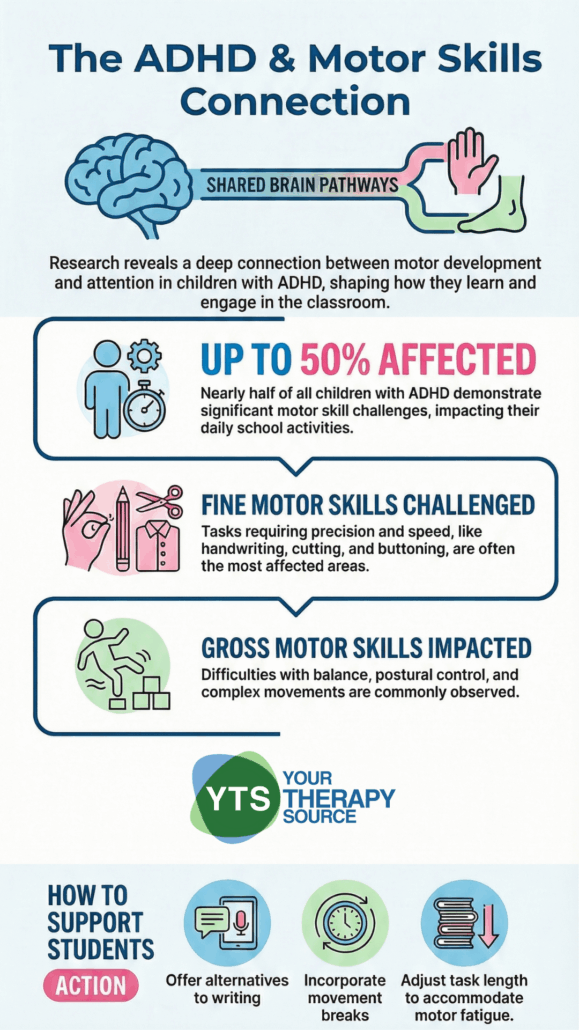
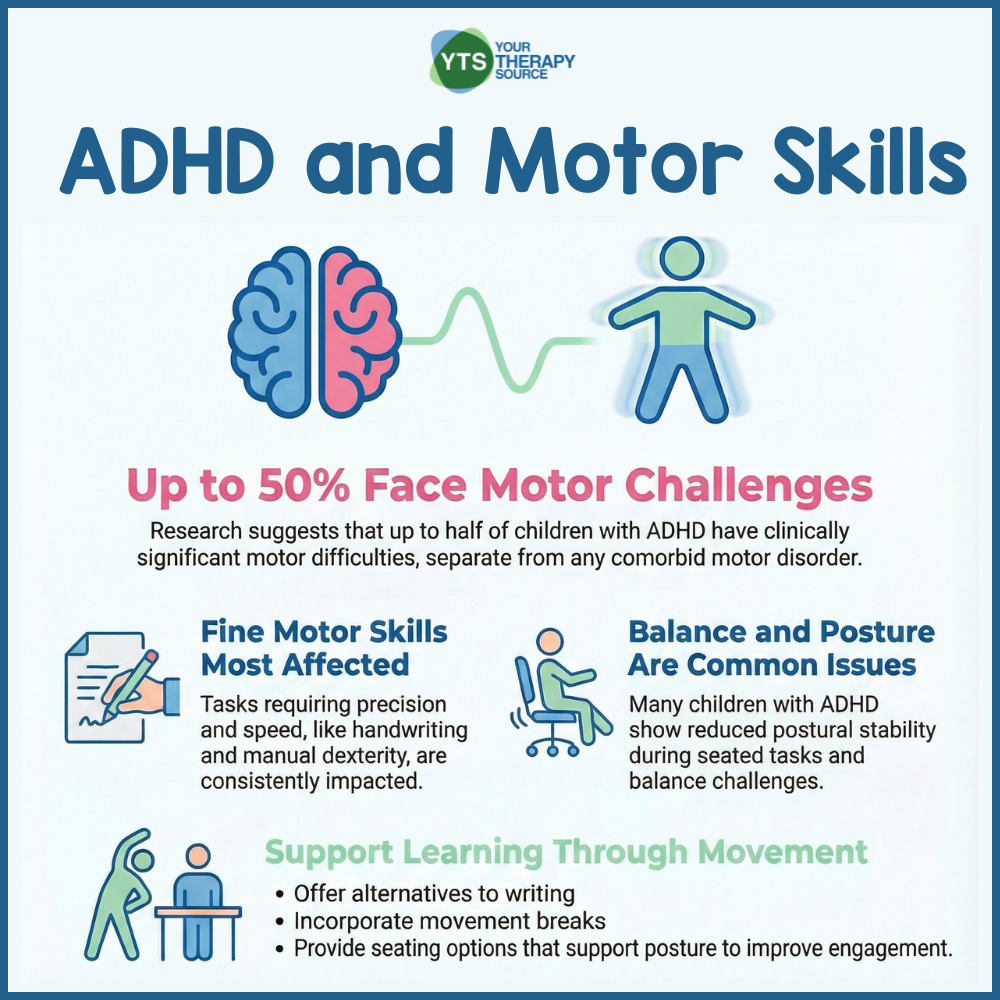
- Motor difficulties are highly prevalent in children with ADHD, with estimates suggesting that up to half of children with ADHD demonstrate clinically significant motor challenges. These motor differences are observed even when developmental coordination disorder is not present, indicating that motor difficulties are not solely explained by comorbid motor diagnoses .
- Fine motor skills appear to be the most consistently affected area, particularly tasks requiring precision, speed, and coordination. Studies reviewed reported differences in handwriting legibility and speed, manual dexterity tasks such as pegboard performance and finger sequencing, and visuomotor integration. These fine motor challenges often persist across childhood and are not fully explained by age, sex, or medication status .
- Gross motor differences are also commonly reported, especially in balance, postural control, and complex movement sequencing. Children with ADHD frequently demonstrate reduced postural stability during standing and dynamic tasks, as well as challenges with locomotor skills and ball-related activities. Balance and postural control difficulties were among the most consistently observed gross motor findings across studies .
- Motor differences may emerge early in development, with longitudinal studies indicating that atypical motor milestone timing, reduced postural control, higher or less regulated motor activity levels, and differences in early action control during infancy are associated with later ADHD symptoms. These early motor patterns were linked to later challenges in sustained attention and executive functioning rather than representing isolated motor delays .
- Neuroimaging evidence supports shared motor and attention-related systems, with findings showing structural and functional differences in motor-related brain networks, including the cerebellum, basal ganglia, and sensorimotor white matter pathways. Variations in these motor systems were associated with both motor performance and attentional regulation, suggesting intertwined developmental pathways .
Together, these findings suggest that motor development and attention-related processes are dynamically linked across development rather than functioning as independent domains.
WHY THESE FINDINGS MATTER FOR EDUCATORS AND RELATED SERVICE PROVIDERS
School environments place ongoing demands on both motor and cognitive systems. Tasks such as handwriting, cutting, organizing materials, sitting upright during instruction, participating in physical education, and navigating classroom transitions all rely on efficient motor control. Understanding the relationship between motor development and ADHD helps school-based professionals:
- View academic and behavioral challenges within a broader developmental context
- Recognize that motor demands may influence attention, endurance, and task engagement
- Support access and participation without attributing difficulties solely to behavior or motivation
IMPLICATIONS FOR SCHOOL STAFF
These findings highlight the importance of observing how motor demands interact with learning and behavior throughout the school day. Recognizing these patterns supports collaborative problem-solving and informed instructional decisions. School staff may notice that students with attention-related challenges:
- Fatigue more quickly during fine motor tasks such as writing, coloring, or cutting
- Struggle to maintain posture during seated instructional activities
- Show reduced accuracy or increased variability as motor demands increase
- Perform differently depending on task length, complexity, or environmental setup
PRACTICAL STRATEGIES OR CONSIDERATIONS
The research supports flexible, participation-focused approaches that account for motor demands within everyday classroom activities. Helpful considerations include:
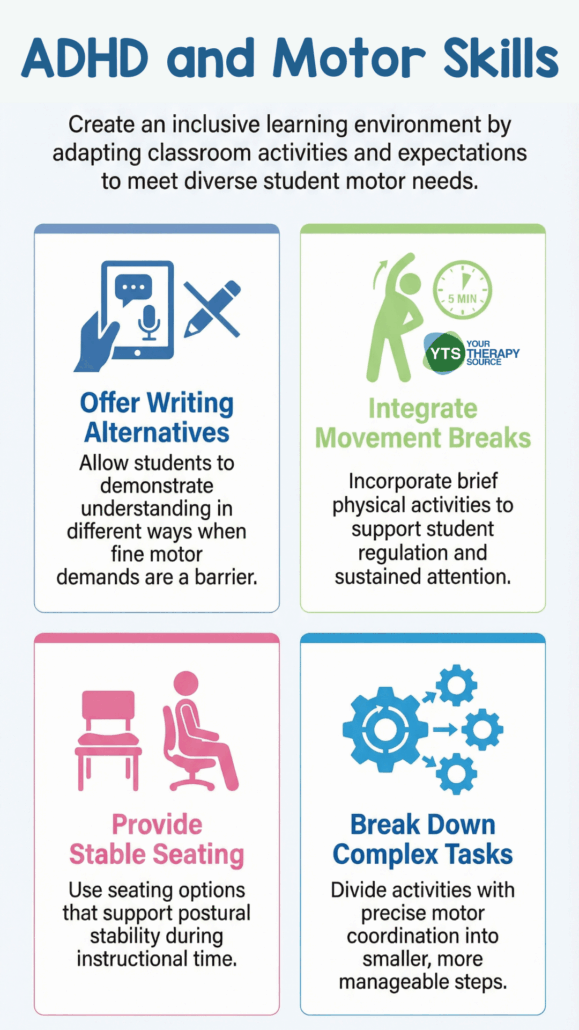
- Offering alternatives to written output when fine motor demands interfere with demonstrating understanding
- Adjusting task length or workload to account for motor fatigue during handwriting or desk-based work
- Incorporating brief movement opportunities to support regulation and sustained attention
- Providing seating options that support postural stability during instructional time
- Allowing additional time for tasks that require precise motor coordination
- Breaking complex motor tasks into smaller, manageable steps
- Supporting visual-motor demands with clear models, visual cues, or guided practice
- Considering how classroom layout and transitions affect movement and attention demands
- Observing how motor demands interact with executive functioning tasks such as planning and organizing work
- Collaborating across disciplines to align classroom expectations with student motor and attention needs
These considerations emphasize access, engagement, and functional participation rather than remediation. Research examining motor development and ADHD suggests that motor skills, attention, and executive functioning are closely connected across development. For school-based professionals, this understanding supports a broader view of student performance and reinforces the importance of considering motor demands when supporting classroom participation. Research-informed perspectives can guide flexible, thoughtful practices that promote engagement and learning for all students.
RELATED ARTICLES ON MOTOR DEVELOPMENT AND ADHD
- Sensory Processing And Learning
- Sensory Needs In ADHD
- Physical Activity Levels And Preschoolers’ ADHD Symptoms
- Exercise, ADHD Symptoms, And Executive Functions
- ADHD Accommodations Checklist (Free Printable)
REFERENCES
Shimko, G. A., & James, K. H. (2025). The relationship between motor development and ADHD: A critical review and future directions. Behavioral Sciences, 15(5), 576. https://doi.org/10.3390/bs15050576