
12 Sensory Seeking Behavior Strategies That Help Kids Stay on Task in Class
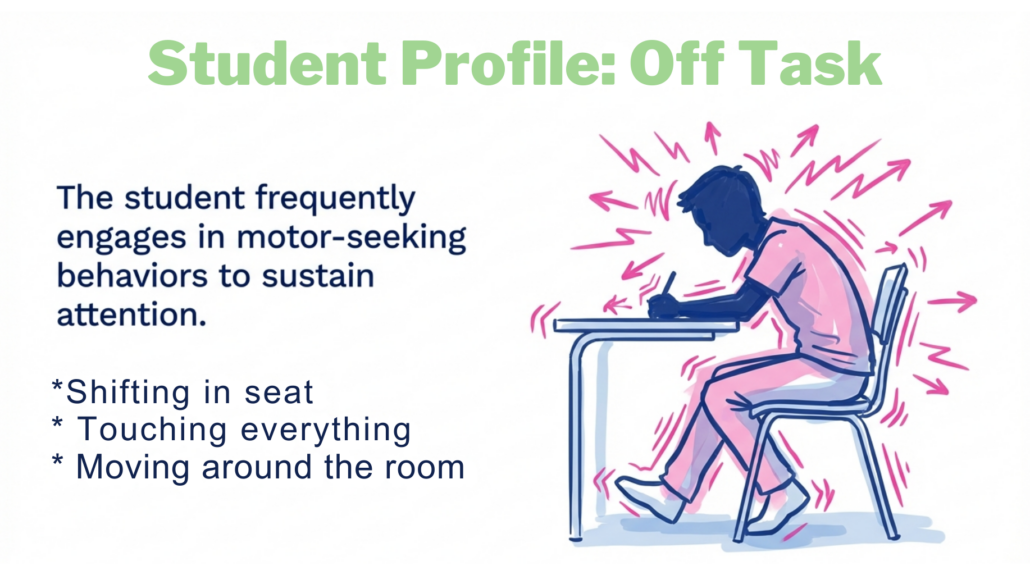
If you’ve ever watched a child who just can’t seem to sit still, constantly fidgets, moves around the room, or touches everything in sight, you may be observing sensory seeking behavior. For many kids, these movements aren’t distractions or defiance. They’re the brain’s attempt to get the sensory input it needs to stay regulated and alert. Students may rely on sensory seeking behavior strategies to help them stay on task in class.
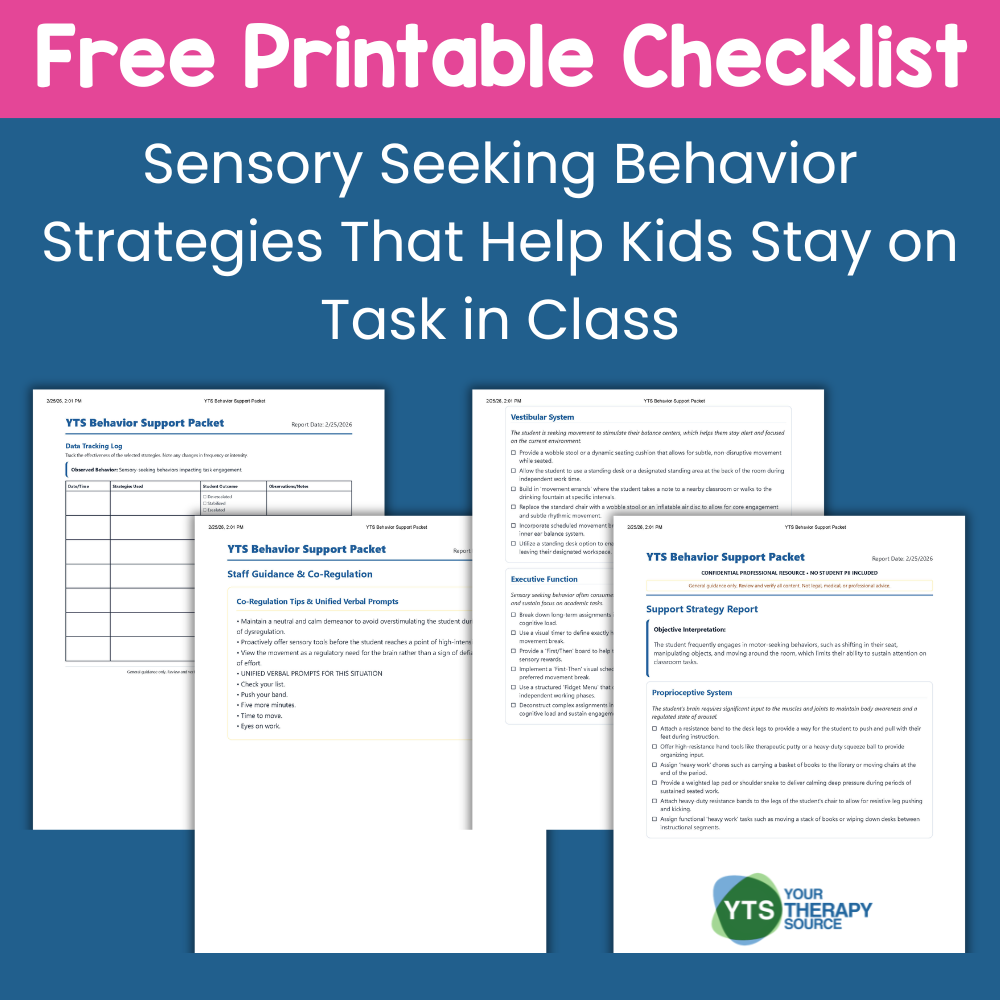
Sensory seeking behavior is one of the most common challenges seen in classrooms, therapy sessions, and at home. It can affect students from preschool through high school, and it often gets misread as a discipline problem rather than a neurological need. Understanding what’s actually driving the behavior is the first step to supporting the student more effectively. You can download a FREE strategy plan at the bottom of the post. It was created with the YTS Action Toolkit.
For a deeper dive into the connection between sensory processing and attention, check out this resource on sensory seeking behaviors and attention span.
What Is Sensory Seeking Behavior?
Sensory seeking, sometimes called sensory-seeking behavior or hyposensitivity, occurs when the nervous system craves more sensory input than it’s receiving. The brain sends signals that prompt the child to move, touch, push, pull, chew, or swing in order to reach a state of regulation: a calm, focused, ready-to-learn state. For a deeper dive into the connection between sensory processing and attention, check out this resource on sensory seeking behaviors and attention span.
Common signs of sensory seeking behavior across age groups include:
- Constantly shifting in the seat, rocking, or bouncing legs
- Touching objects, walls, or classmates frequently
- Chewing on pencils, shirt collars, or other non-food items
- Seeking out rough play or crashing into furniture
- Difficulty staying in one place during structured activities
- Humming, making noises, or tapping surfaces
It’s worth noting that sensory seeking looks different depending on the child’s age and sensory profile. A preschooler might roll on the floor constantly, while a middle schooler might tap their feet, click their pen, or find excuses to get up and walk around. For more on how sensory responses affect behavior, see this overview of sensory over-responsivity and behavior.
Why Sensory Seeking Disrupts Task Engagement
When a child is in a state of sensory under-arousal, their brain is essentially understimulated. In this state, sustaining attention on tasks that require sitting still and focusing is genuinely difficult, not because the child doesn’t want to comply, but because their nervous system is working against them.
The sensory seeking behaviors serve a regulatory function: they help raise the child’s arousal level so they can engage. The problem is that unmanaged sensory seeking often disrupts the learning environment, exhausts the child’s cognitive resources, and creates friction with teachers and peers.
This also has a significant impact on executive function. When the brain is focused on managing sensory needs, there’s less capacity available for planning, initiating tasks, and sustaining focus. If you’re supporting a student who struggles to get started on assignments or stay engaged, this article on task initiation is an excellent companion read.
Proprioceptive Strategies: Giving the Body What It Needs
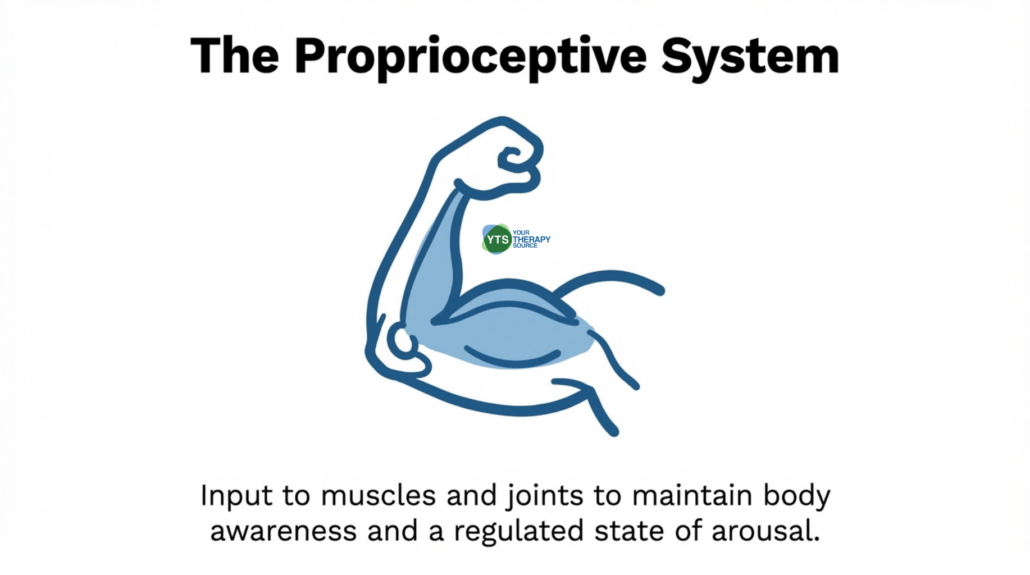
The proprioceptive system processes input from muscles and joints and is one of the most powerful regulatory systems in the body. “Heavy work” activities provide resistance or deep pressure which can have a calming and organizing effect on the nervous system that lasts 1–2 hours.
For classroom and home use, consider these proprioceptive strategies:
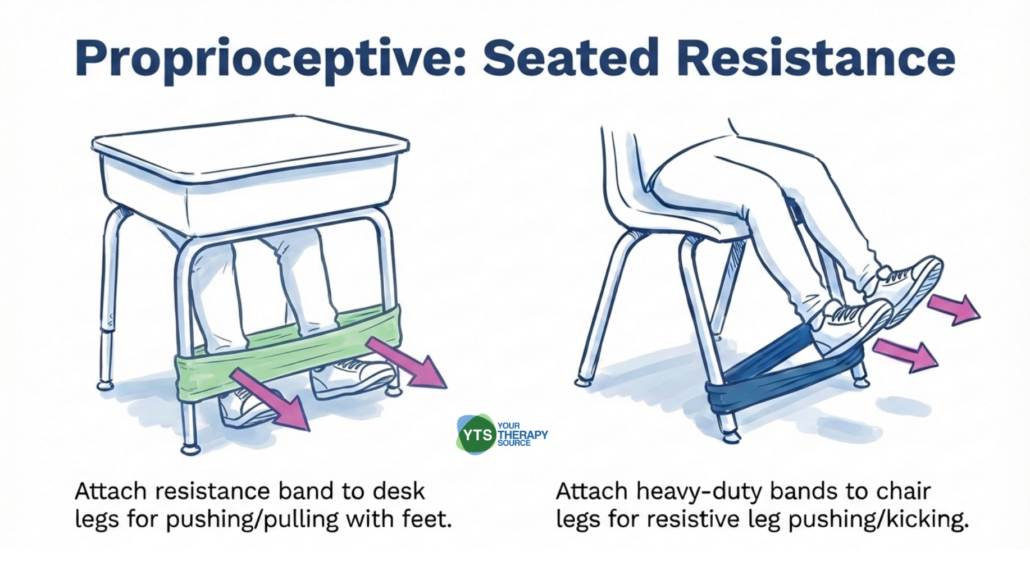
- Attach a resistance band to desk or chair legs so the student can push and pull with their feet during instruction
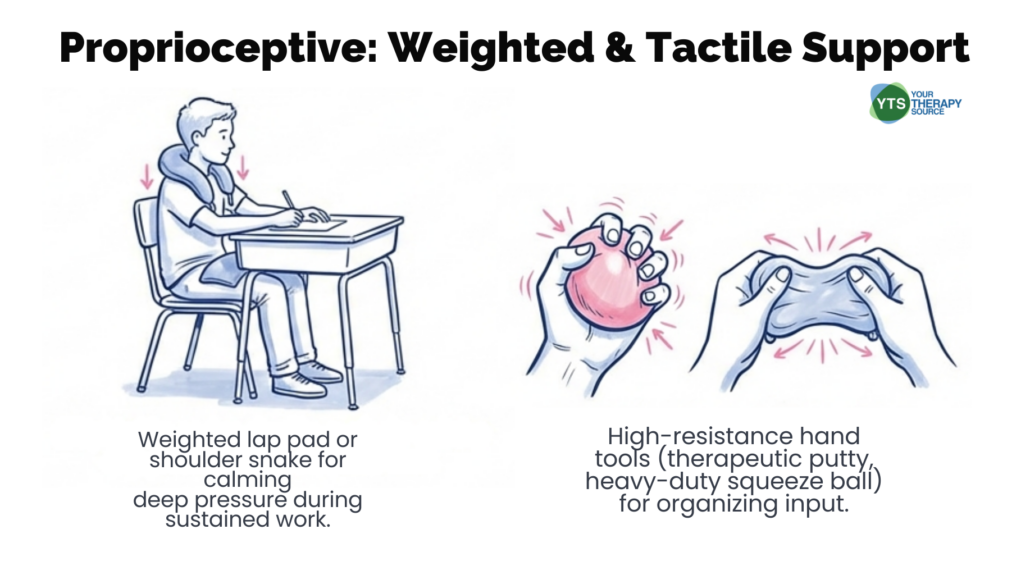
- Offer therapeutic putty, a heavy-duty squeeze ball, or a stress ball for use during listening activities
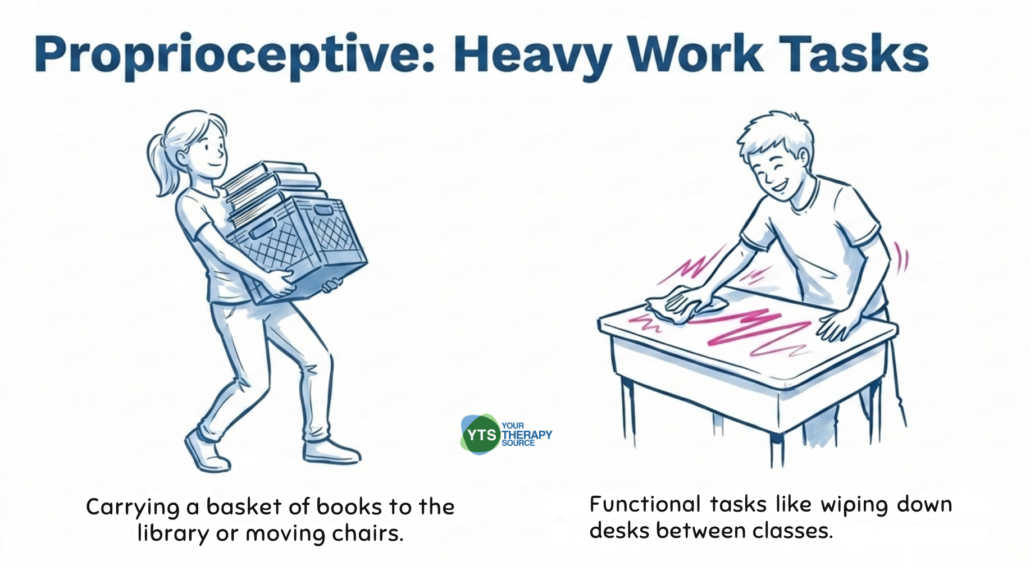
- Assign heavy work jobs such as carrying books, moving chairs, delivering items between classrooms, or wiping down tables
- Use a weighted lap pad during sustained seated work to provide calming deep pressure input
- Build in wall push-ups, chair push-ups, or isometric exercises before transitions or focus-intensive tasks
These strategies work across age groups and can be modified easily. A kindergartener might love being the “book carrier,” while a high schooler can discreetly use therapeutic putty under their desk.
Vestibular Strategies: Supporting the Need to Move
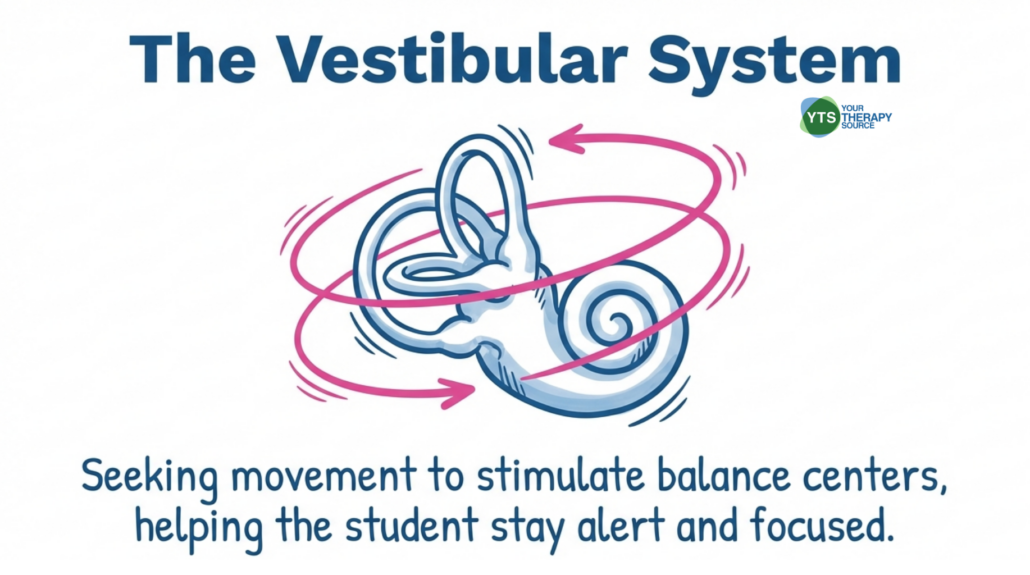
The vestibular system is located in the inner ear and governs balance, spatial orientation, and alertness. Children who seek vestibular input are often the ones spinning, swinging, rocking, or pacing. They need movement to stay alert and focused.
Rather than fighting this need, the goal is to channel it productively:
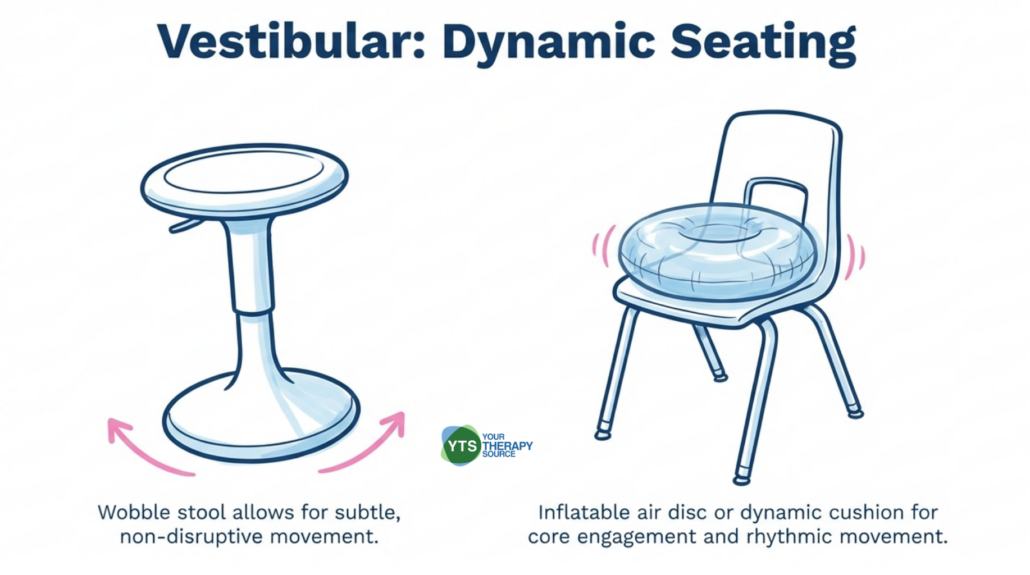
- Replace the standard chair with a wobble stool, balance disc, or inflatable seating cushion that allows subtle, continuous movement
- Offer a standing desk option or a designated standing area during independent work time
- Build in structured movement errands i.e. delivering a note to the office, walking to the water fountain, or taking a lap around the hallway
- Incorporate short movement breaks that include head tilts, slow rotations, or marching in place to activate the vestibular system
- Allow the student to stand or move to a different spot in the room during instruction when appropriate
The key is making movement purposeful and predictable so it becomes a regulated part of the day rather than a constant interruption.
Oral Sensory Strategies: Don’t Overlook the Mouth
Oral sensory seeking is extremely common and often goes unaddressed. Children who chew on pencils, shirt collars, or their fingers, or who make noise with their mouth, may be seeking oral proprioceptive input to self-regulate.
Appropriate strategies include:
- Providing a chewable jewelry tool or chew tube as a safe, socially acceptable alternative to chewing on objects
- Offering crunchy or chewy snacks during homework or study time at home
- Allowing the use of a water bottle with a straw during class — the sucking action provides significant oral input
- Using gum or chewy candy at home during homework if developmentally and contextually appropriate
For a comprehensive guide on this topic, visit this article on oral sensory seekers.
Executive Function Supports That Work Alongside Sensory Strategies
Sensory seeking behaviors consume significant cognitive energy, making it harder to initiate, plan, and follow through on tasks. Pairing sensory supports with executive function scaffolds produces better outcomes than either approach alone.
Effective supports include:
- Breaking assignments into small, numbered micro-tasks on a visual checklist to reduce cognitive load
- Using a visual timer to define exactly how long the student needs to work before accessing a movement break
- Providing a First/Then board that explicitly links task completion to a preferred sensory reward
- Creating a Fidget Menu: a simple list of approved sensory tools appropriate for different phases of the lesson, such as listening vs. independent work
- Using consistent, neutral verbal prompts like “Check your list,” “Push your band,” “Five more minutes,” or “Time to move”
Predictability is powerful for sensory-seeking students. When they know a movement break is coming and what the expectations are, their brain can settle into the task more easily.
Staff and Parent Co-Regulation Tips
The adult’s response to sensory seeking behavior matters enormously. A calm, regulated adult helps co-regulate a dysregulated child. Here are key co-regulation principles for staff and parents:
- Maintain a neutral, calm demeanor when the student is in a heightened state. Avoid raised voices or rapid movement that can further dysregulate
- Offer sensory tools proactively before the behavior escalates, rather than reactively after it has
- View the movement and seeking behavior as a neurological need, not defiance or lack of effort
- Collaborate with the student to identify which tools and strategies feel most helpful. Student buy-in improves consistency
- Communicate across environments so strategies used in school are reinforced at home
Consistency between school and home is one of the strongest predictors of success. When parents and teachers use the same language and tools, students internalize regulation strategies more quickly.
Tracking What Works: Using Data to Guide Strategy Selection
Not every strategy works for every child, and sensory needs can shift over time. Keeping a simple data log helps identify patterns, measure progress, and determine which strategies are most effective.
A basic tracking format can include the date and time, which strategy was used, and whether the student de-escalated, stabilized, or escalated after the strategy was implemented. Even a brief anecdotal note about the context can reveal important trends over time.
Regularly reviewing this data, even informally between a teacher and a parent, creates a feedback loop that continuously improves the support plan.
Tools and Resources from the YTS Action Toolkit
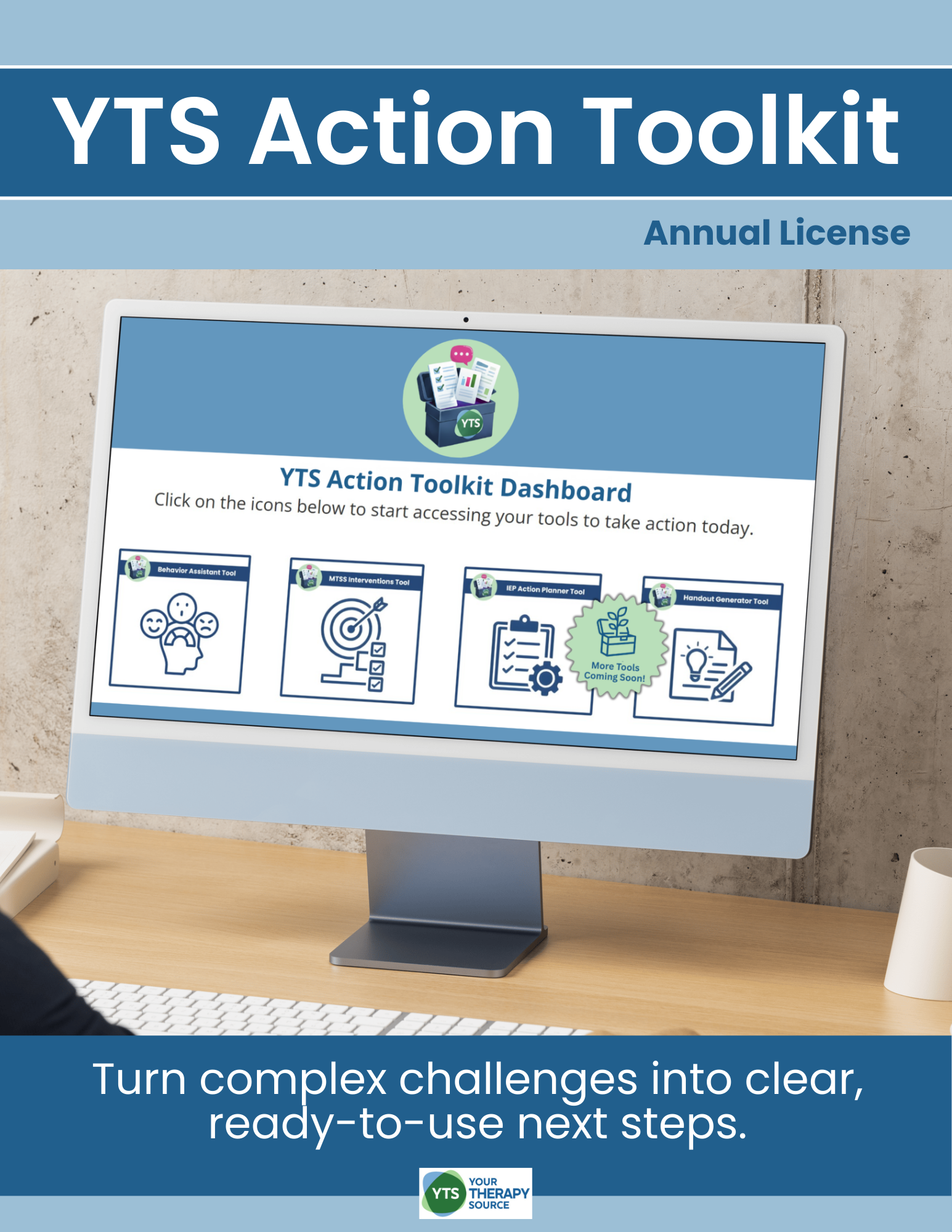
If you’re looking for a structured, printable resource to support sensory-seeking students, the YTS Action Toolkit provides ready-to-use behavior support packets that include system-specific strategies for the proprioceptive, vestibular, and executive function systems, unified verbal prompts for staff, and a data tracking log.
The toolkit is designed for school-based professionals including OTs, PTs, and behavior support staff, but is also accessible for parents looking for evidence-informed approaches to use at home.
Download your FREE Copy of the Checklist
Sensory seeking behavior is not a behavior problem to be managed. It’s a regulatory need to be supported. When the right strategies are in place, students who are sensory seekers can absolutely thrive in structured environments. The goal is to work with the nervous system rather than against it, providing the input the brain needs so that attention, learning, and connection can follow.
With the right tools, consistent implementation, and a collaborative approach between school and home, sensory-seeking students can build regulation skills that serve them not just in the classroom, but throughout their lives.
Enter your email to access your FREE checklist.

