
Demand Avoidance in Autistic Students: Sensory Clues
Demand avoidance in autistic students is one of the most challenging patterns school-based teams encounter. Students may refuse tasks, withdraw, shut down, or resist transitions in ways that are difficult to interpret without understanding the underlying factors driving these responses. When a child also identifies with a Pathological Demand Avoidance (PDA) profile, the picture can become even more complex.
A 2026 study published in Research in Autism examined what distinguishes demand avoidance behaviors in children and adolescents who are autistic with and without PDA, specifically looking at the roles of sensory reactivity and intolerance of uncertainty. The findings offer school-based professionals a more grounded way to understand why some students experience extreme demand avoidance, and what environmental factors may be contributing.

WHAT THE RESEARCH EXAMINED
This study set out to identify the specific factors that drive extreme demand avoidance (EDA) in autistic children with and without a PDA profile, and to compare those patterns to a neurotypical control group. The researchers focused on whether sensory reactivity and intolerance of uncertainty (IU) predict demand avoidance behaviors, even after accounting for anxiety and autistic traits.
Key study details:
- 795 children and adolescents between ages 4 and 17 were included in the final analysis
- Three groups were compared: autistic children with PDA (n=475), autistic children without PDA (n=171), and neurotypical controls (n=94)
- Parent caregivers completed an online questionnaire including validated measures of demand avoidance, anxiety, autistic traits, sensory processing, and intolerance of uncertainty
- Participants were recruited through UK schools, the PDA Society UK, and social media
- The majority of children with autism and PDA had at least one co-occurring condition, with ADHD being the most common
KEY FINDINGS FROM THE RESEARCH ON DEMAND AVOIDANCE
Overall, higher levels of anxiety and autistic traits were associated with higher demand avoidance behaviors across all three groups. However, what distinguished the groups was more specific.
Key findings include:
- Sensory reactivity, specifically tactile sensitivity and sensory seeking, was the only significant predictor of EDA in the autism with PDA group, above and beyond anxiety and autistic traits
- Intolerance of uncertainty (IU) was a significant predictor of EDA only in the neurotypical control group, not in either autistic group
- Neither sensory reactivity nor IU significantly predicted EDA in the autistic group without PDA
- In the autism with PDA group, the sensory dimensions of tactile sensitivity, taste/smell sensitivity, and under-responsive/sensory seeking behavior significantly predicted demand avoidance levels
- Demand avoidance behaviors were found to decrease with age, a pattern that was most pronounced in the autism with PDA group
WHY THESE FINDINGS MATTER FOR SCHOOL-BASED PRACTICE
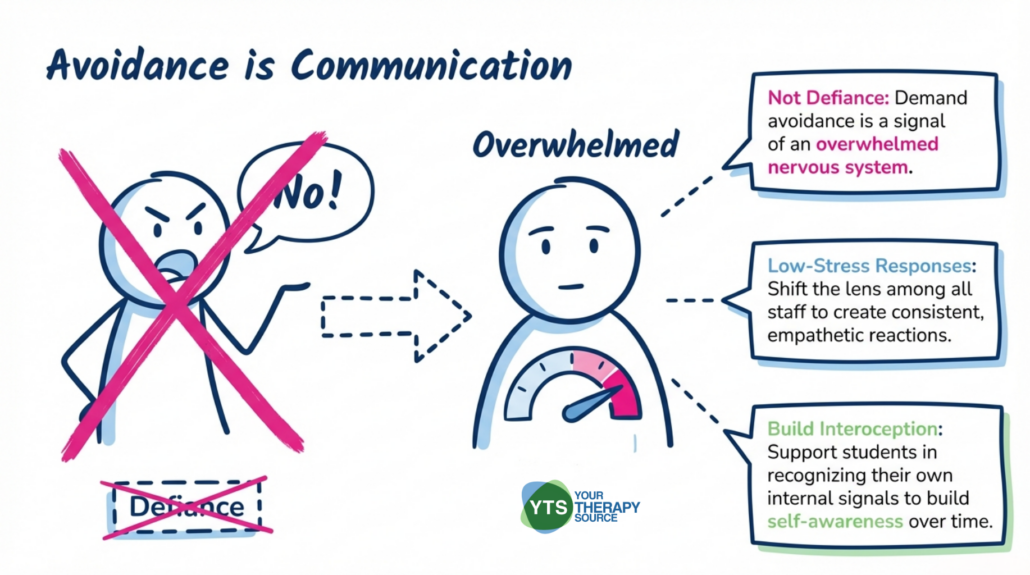
These findings suggest that demand avoidance in students with a PDA profile may not be primarily about the task itself, but about the sensory experience surrounding it. When school environments are unpredictable or sensory-demanding, avoidance behaviors may increase as a way of managing overwhelm.
Standout points for school-based professionals:
- Tactile sensitivity and sensory seeking were the unique predictors of EDA for students with autism and PDA, meaning sensory experience may be driving avoidance more than intolerance of uncertainty in this group
- EDA behaviors may function as a coping mechanism for anxiety in students with high sensory reactivity, particularly when environments feel overwhelming
- The study suggests that demand avoidance may reflect a student’s response to their environment rather than defiance or a lack of motivation
Understanding sensory processing patterns in students with PDA can help teams shift from a behavior-focused lens to an environment-focused one. For a closer look at how a student refusing to do work may be communicating unmet sensory or regulatory needs, that framing is a useful starting point for school-based planning.
IMPLICATIONS FOR SCHOOL STAFF
These findings point to the importance of recognizing sensory reactivity as a possible driver of demand avoidance in students with a PDA profile. What looks like refusal may reflect a student’s attempt to regulate in the face of sensory stress. Difficulty with task initiation is often connected to this same underlying regulatory challenge, and understanding the sensory context can help staff respond more effectively.
Staff may notice students who:
- Resist or avoid tasks that involve physical contact, textures, or unexpected touch
- Seek out intense sensory input or appear dysregulated without clear cause
- Shut down or withdraw in noisy, crowded, or visually busy environments
- Show behavior that varies significantly between settings, such as home versus school
This research reinforces the value of looking at the full sensory environment when a student is struggling with demand avoidance. A strengths-based, multi-modal approach that considers sensory needs alongside social, emotional, and regulatory supports can help teams design more individualized and effective strategies for students with complex profiles.
10 PRACTICAL STRATEGIES OR CONSIDERATIONS FOR DEMAND AVOIDANCE
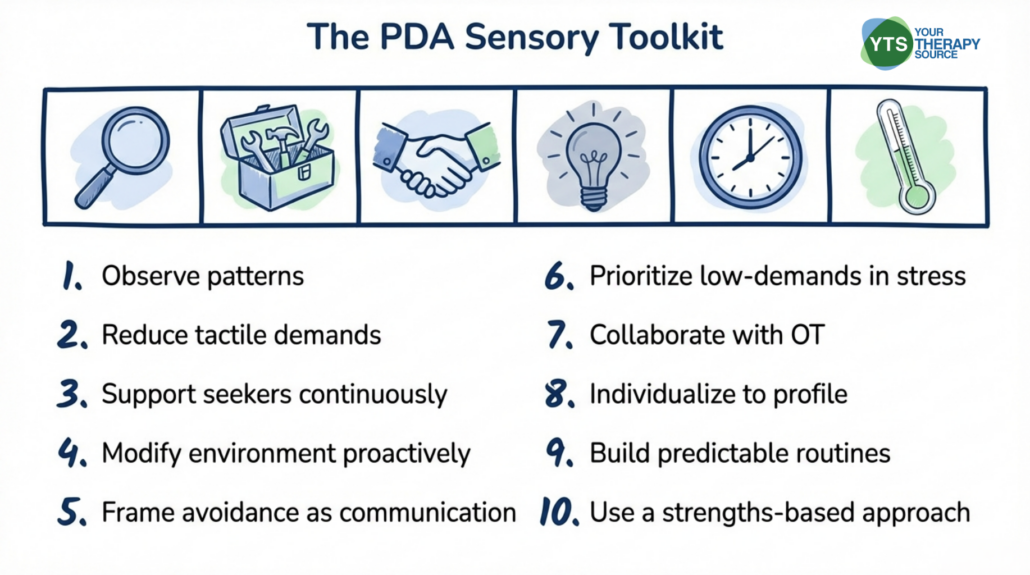
- Observe sensory patterns alongside behavior. When a student with a PDA profile engages in demand avoidance, document the sensory context. Note the environment, the type of task, and the sensory demands present. This information can help teams identify patterns that may not be immediately visible.
- Reduce tactile demands where possible. Since tactile sensitivity was a significant predictor of demand avoidance in students with autism and PDA, consider how materials, clothing requirements, and physical prompts may be contributing to avoidance. Offering choices in how a task is completed can reduce sensory friction.
- Support sensory seekers with regulated opportunities. Students who under-respond to sensory input and seek stimulation may be more regulated when movement, fidgets, or other sensory tools are incorporated naturally throughout the day rather than reserved for specific times.
- Modify the sensory environment proactively. The research discussion suggests that adjustments such as dimming lights, reducing noise, or providing a quiet space for self-regulation may support students with PDA who are managing sensory overwhelm. These changes can be made without requiring any action from the student.
- Frame avoidance as communication. Rather than interpreting demand avoidance as defiance, consider it a signal that the student’s nervous system is overwhelmed. Shifting this lens among all staff helps create more consistent, low-stress responses. Supporting students in recognizing their own internal signals is part of this work, and interoception in the classroom offers one avenue for building that self-awareness over time.
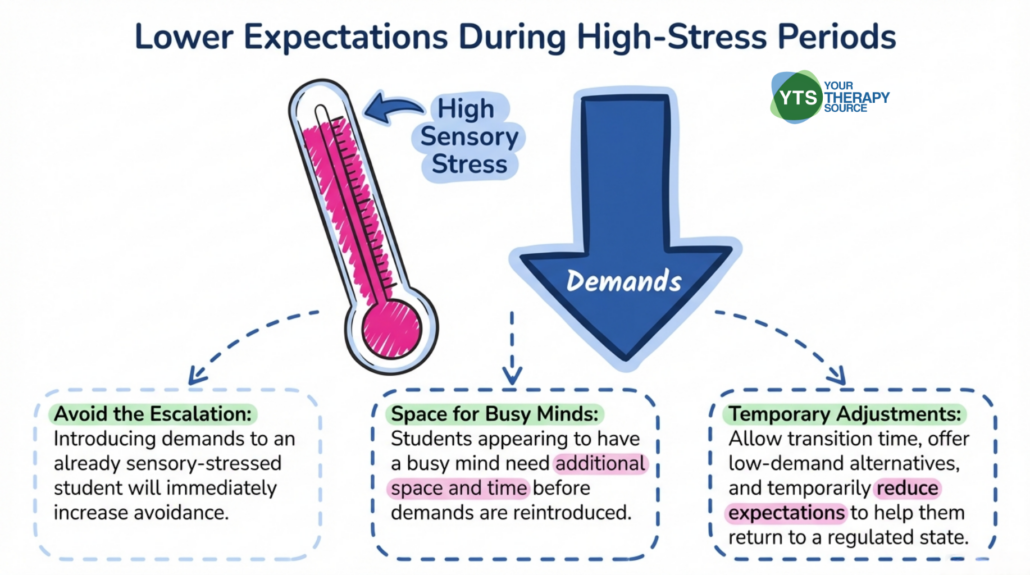
- Prioritize low-demand approaches during high-sensory periods. When a student is already sensory-stressed, introducing additional demands is likely to increase avoidance. Allowing transition time, offering low-demand alternatives, or reducing expectations temporarily may support the student in returning to a regulated state. Students who appear to have a busy mind may need additional space before demands are reintroduced.
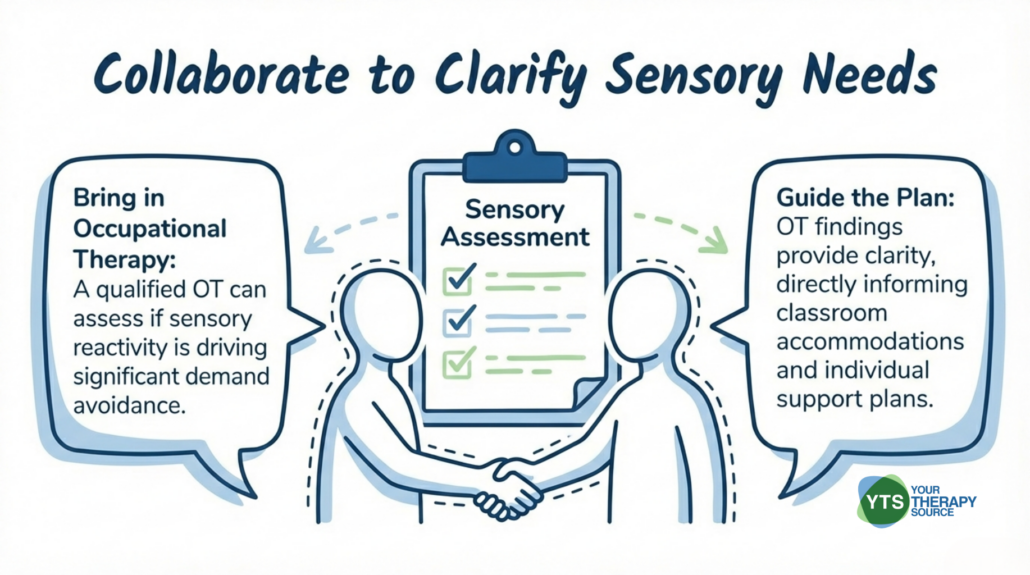
- Collaborate with occupational therapy to assess sensory needs. If a student has a PDA profile and significant demand avoidance, a sensory assessment by a qualified occupational therapist can help clarify whether sensory reactivity is contributing. This information can guide classroom accommodations and individual support plans.
- Individualize strategies based on sensory profile. Because sensory reactivity is not uniform, supports need to be tailored. A student who is hypersensitive to touch requires different accommodations than one who primarily seeks sensory input. Universal strategies are unlikely to address the underlying factors for each child.
- Consider the role of predictability in sensory regulation. This study found that sensory input may feel more distressing when it is unexpected. Building predictable routines, giving advance notice of transitions, and using visual schedules can reduce the unpredictability of sensory experiences across the school day. Developing emotional intelligence in students can also support their ability to recognize and communicate when they are approaching overwhelm.
- Approach assessment and planning from a strengths-based perspective. The research authors suggest that recognizing sensory needs in students with PDA supports a strengths-based approach to assessment and intervention. Identifying what helps a student feel regulated and safe is a more effective starting point than focusing solely on reducing avoidance behaviors.
CONCLUSION
This study offers an important shift in how school-based professionals might understand demand avoidance in students with an autism and PDA profile. Sensory reactivity, particularly tactile sensitivity and sensory seeking, may be a key underlying factor in driving extreme demand avoidance for this group, even when anxiety and autistic traits are accounted for. This finding challenges teams to look beyond the behavior itself and consider the sensory environment surrounding it.
For educators, occupational therapists, and related service providers, these findings support an approach to demand avoidance that is individualized, environment-focused, and grounded in an understanding of each student’s sensory profile. By recognizing that avoidance may reflect a student’s attempt to cope with sensory stress, teams can design more informed supports that address the root of the behavior rather than its surface presentation.
REFERENCES
Rai, A. J., Rishworth, B., Gutierrez, R., & Ludlow, A. K. (2026). Sensory reactivity and intolerance to uncertainty: What characterises demand avoidance behaviours in children and adolescents with pathological demand avoidance? Research in Autism, 131, 202816. https://doi.org/10.1016/j.reia.2026.202816

