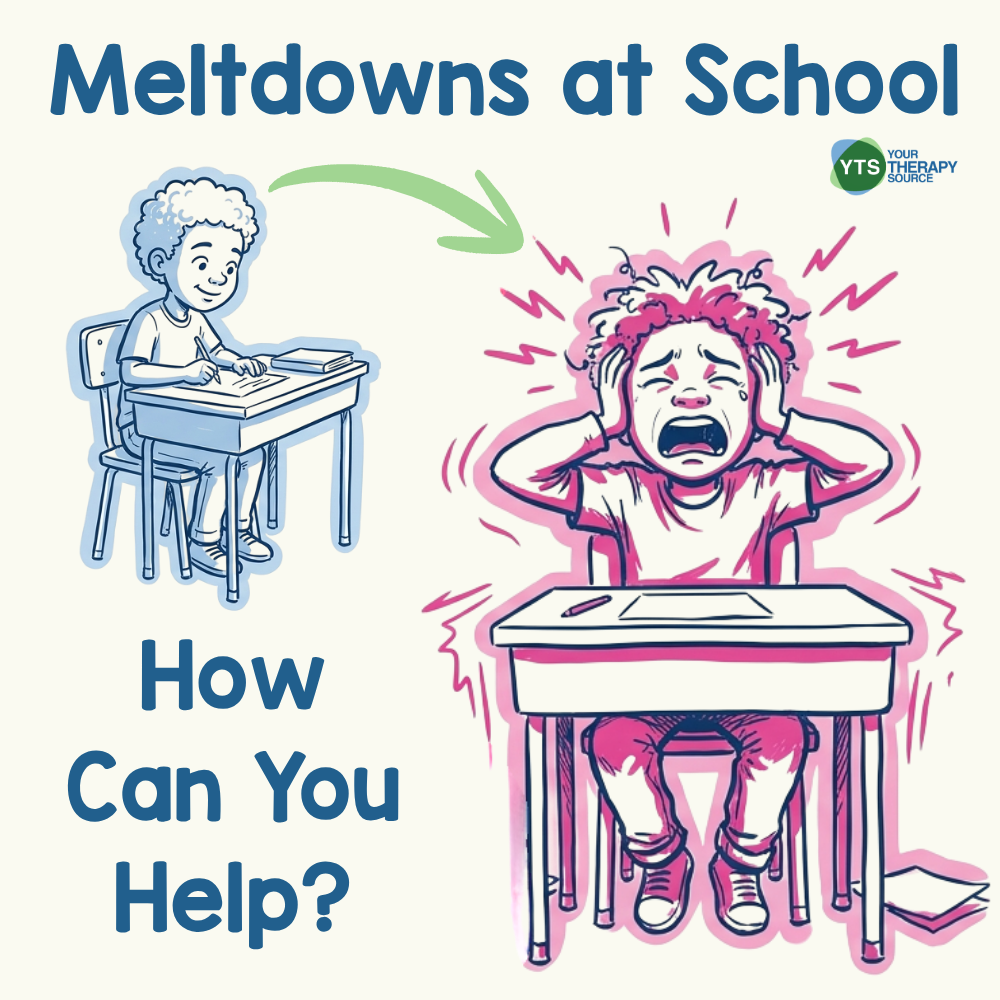
Meltdowns at School: How Can You Help?
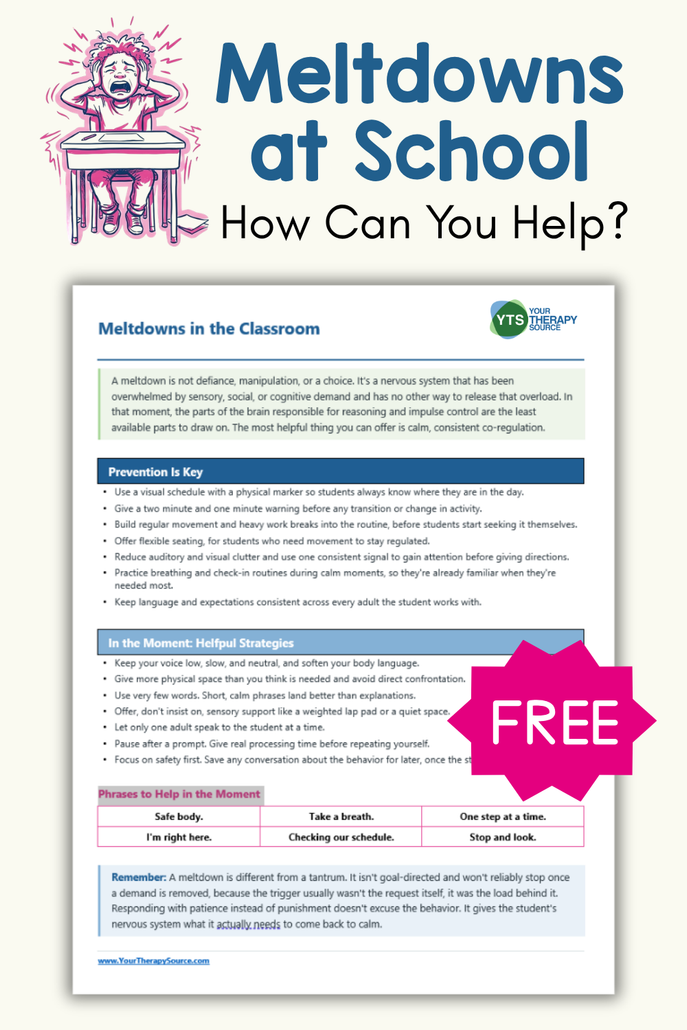
If you work in a school, you’ve seen meltdowns at school. A student who was fine five minutes ago is suddenly crying, screaming, or refusing to move, no matter what you try. It’s intense, it’s disruptive, and it’s easy to read as “bad behavior.” But a meltdown isn’t a choice a student is making. It’s a nervous system that has hit its limit. Understanding what’s happening underneath the behavior is the first step toward actually helping. You can download a FREE handout at the bottom of the page.
What Is a Meltdown, Really?
From a neuroinclusive lens, a meltdown is not defiance, manipulation, or a bid for attention. It’s an involuntary response to a nervous system that has exceeded its capacity to cope, whether the demand is sensory, environmental, social, or academic. The student isn’t choosing to shut down or scream any more than someone chooses to flinch from a loud noise. Their brain has shifted into a survival response, and in that state, the parts of the brain responsible for reasoning, language, and impulse control are the least available parts to draw on.
This distinction matters because it changes what adults do next. A behavior plan built on the assumption of willful defiance leads to consequences and control. A plan built on the assumption of dysregulation leads to co-regulation and support. Same student, very different outcomes.
Meltdown vs. Tantrum
It’s common for meltdowns and tantrums to get lumped together, but they are not the same thing, and telling them apart changes how adults should respond. A tantrum is typically goal directed. A student wants something, like a toy, a turn, or an extended screen time, and the behavior usually eases up once the desired outcome is reached or the student sees it isn’t coming. A tantrum also tends to include some awareness of an audience, easing when adults step away and escalating when adults engage.
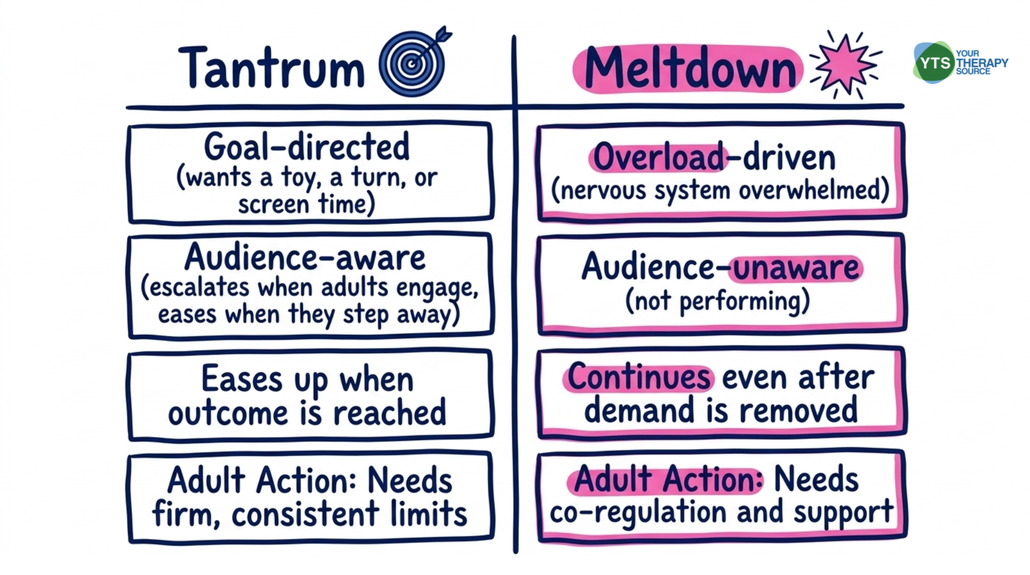
A meltdown looks different. It isn’t about getting something, it’s about a nervous system that has been overwhelmed and has no other way to release that overload. A meltdown doesn’t reliably stop once a demand is removed or a request is granted, because the trigger was rarely the request itself, it was the sensory, social, or cognitive load behind it. A student in a meltdown also isn’t performing for an audience the way a student having a tantrum often is, and simply walking away doesn’t make it stop.
Why does this distinction matter for the classroom? Responding to a tantrum with firm, consistent limits is reasonable. Responding to a meltdown the same way, as if it were a bid for attention or control, misses what’s actually happening and can make things worse. Recognizing which one you’re seeing is the first step to responding effectively.
Behavior Is Communication
Every meltdown is telling you something, even when the student can’t tell you themselves. Screaming during a transition might be communicating that the change feels unpredictable and unsafe. Refusing to move might be communicating that the student’s body doesn’t have the information it needs to feel secure right now. Crying during a demand might be communicating that the request has simply outpaced what the student can process in that moment.
Instead of asking how do I stop this behavior, a more useful question is what is this behavior trying to tell me, and what does the student need instead. That reframe opens the door to strategies that address the root cause, rather than strategies that just suppress the visible symptom.
An Action Plan for Teachers and Support Staff to Help with Student Meltdowns at School
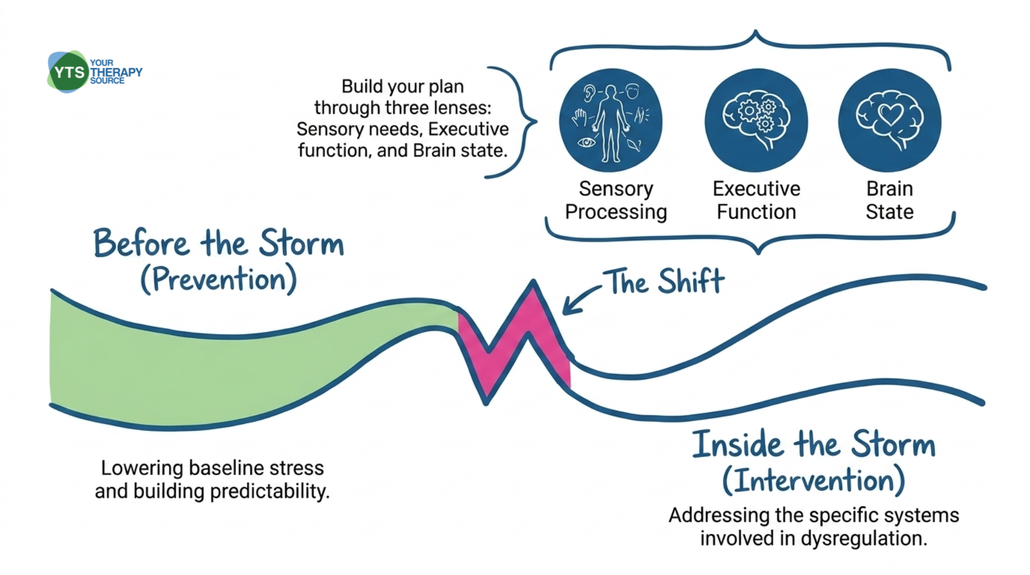
Once a team understands that a meltdown is a nervous system event rather than a discipline issue, the next step is building a practical plan. A strong plan works on two timelines: what adults do before dysregulation happens, and what strategies address the specific systems involved once a student is already struggling. The sections below walk through both, starting with prevention.
A helpful way to organize strategies is to think across three lenses: sensory processing, or what the body needs to feel regulated, executive function, or what the brain needs to process demands, and the difference between a calm brain and an alarm brain, since a student in survival mode needs a very different response than a student who is simply learning a new skill.
10 Key Strategies to Prevent a Meltdowns at School
Prevention works by lowering a student’s baseline stress and building predictability into the day, so fewer moments tip into overload in the first place.
- Use a consistent visual schedule with a physical marker so students can always see exactly where they are in the day’s routine.
- Give a two minute and one minute visual timer warning before any change in activity.
- Build regular proprioceptive heavy work into the day, like pushing a cart of books or carrying a stack of chairs, especially before transitions.
- Offer flexible seating options, such as wobble stools, rocker chairs, or resistance bands on chair legs, for students who need movement to stay regulated.
- Lead short, whole-class body breaks with wall push-ups, chair push-ups, or bear crawls before tasks that require sitting still.
- Reduce auditory overload by minimizing background noise and using a consistent non-verbal signal, like a chime or a specific clap, to gather attention before giving directions.
- Reduce visual clutter in the classroom and highlight key information with high contrast colors so the brain has less to filter through.
- Practice daily whole-class co-regulation, like rhythmic breathing or slow stretching, during morning meetings and after high energy transitions.
- Use a visual check-in board where students can identify their current energy or feeling state using non-judgmental icons or colors.
- Keep adult responses consistent across staff, using the same unified language and approach, so the environment feels predictable rather than alarming.
10 Key Strategies to Help a Student During a Meltdown
Once a student has shifted into an alarm brain state, the goal changes from teaching to co-regulating. Logic, lengthy explanations, and new information are hard to process here, so these strategies focus on safety, sensory support, and simplicity.
- Maintain a calm, neutral tone of voice and keep your body language soft and non-threatening.
- Give more physical space than you think is needed to help the student feel safe rather than cornered.
- Reduce language to single words or short phrases, since a dysregulated brain cannot process complex speech in the moment.
- Use short, unified verbal prompts like “safe body,” “take a breath,” or “one step at a time” instead of longer explanations.
- Offer deep pressure input, such as a weighted lap pad or a “burrito wrap” with a heavy blanket, if the student is receptive to it.
- Allow access to a calm down space with soft seating and familiar sensory tools the student can use voluntarily.
- Try slow, rhythmic movement or swaying to help organize the nervous system, rather than asking the student to sit perfectly still.
- Minimize how many adults are speaking to the student at once, so there is only one calm voice to focus on.
- After giving a prompt, use a wait and see approach that gives the student real processing time before repeating or adding more language.
- Prioritize physical safety first, and postpone any discussion of the behavior until the student’s brain has shifted back to calm.
From Observation to Action: How the Behavior Support Assistant Helps
Figuring out the why behind a meltdown, and translating it into a workable plan, takes time most educators and therapists don’t have in the middle of a busy day. That’s where a tool like Your Therapy Source’s Behavior Support Assistant comes in.
Here is an example output from the tool, generated from a description of a pattern of significant dysregulation across a group of students, including aggression, bolting, difficulty sharing, and trouble processing multi-step verbal directions in a busy K-2 classroom.
The report organizes the behavior into the underlying systems covered above, emotional regulation, executive function, proprioceptive, and vestibular, and adds two more that are easy to overlook: auditory processing, since background noise can make it hard to filter out a teacher’s voice, and visual processing, since classroom clutter can quietly add to a student’s overall load.
It also generates staff guidance, including unified verbal prompts like “safe body,” “checking our schedule,” “one step at a time,” and “take a breath,” so every adult working with the students responds the same way. That consistency matters enormously for students whose brains need predictability to feel safe.
Finally, it produces a data tracking log, so staff can note which strategies were used and whether the student de-escalated, stabilized, or escalated, turning a chaotic moment into information the team can actually use to refine the plan over time.
The result isn’t a generic checklist. It’s a structured starting point that helps teams move from “we don’t know what to try” to “here are three concrete strategies to test tomorrow,” while still leaving room for professional judgment, since every student and every classroom is different.
Getting Started
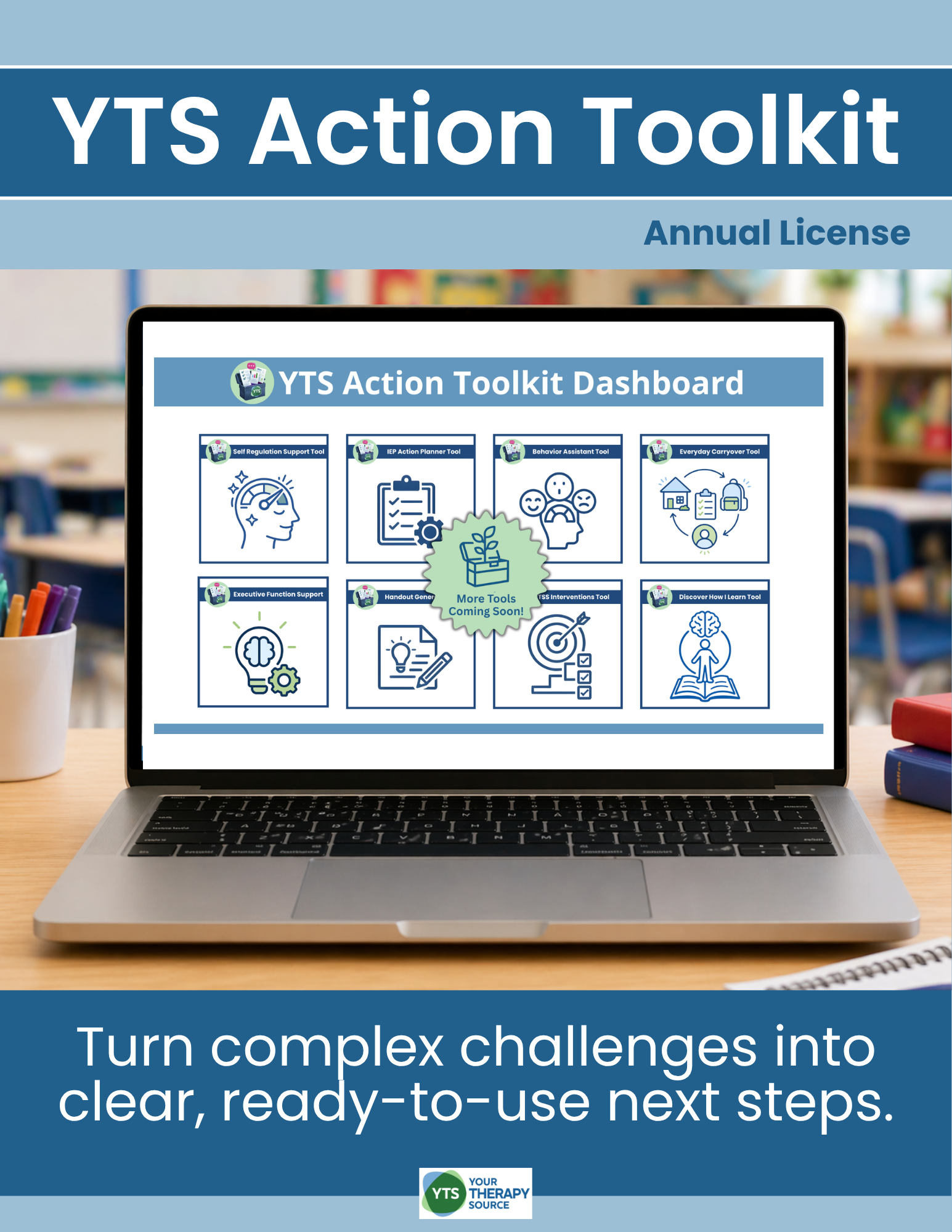
If your team is looking for more tools like this to support students with challenging behaviors, sensory needs, and self regulation, take a look at the YTS Action Toolkit Annual License. It’s built to help school teams turn understanding into action, one student at a time.
General guidance only. Always review and verify strategies with your team, and consult appropriate professionals for individualized student needs.
Download Your FREE Handout on Meltdowns at School Here
Enter your email to access the free handout on meltdowns at school.