
Self Soothing and Self Regulation
Self soothing shows up in classrooms every day, even when adults do not always notice it. A student pulling their sleeves over their hands, hugging their own arms, or rubbing a soft object on their desk may be using a simple, built-in strategy to feel calmer. For educators, occupational therapists, physical therapists, and other school-based staff, understanding self soothing gives helpful context for behaviors that are often misread as distraction or defiance.
These behaviors are not unique to any one group of students. Neurotypical and neurodivergent children both rely on self soothing to manage stress, sensory input, and big emotions throughout the school day. Looking at the research behind self soothing can help school teams respond with understanding instead of correction.
WHAT IS SELF SOOTHING?
Self soothing refers to behaviors a person uses on their own, without help from another person, to calm their body and mind. It often involves touch, movement, or repetitive sensory input, and it can happen automatically, without much conscious thought. Self soothing shows up across the lifespan, from infants to adults, and is considered a normal part of how people manage stress.
HOW DOES SELF SOOTHING SUPPORT SELF REGULATION?
Self regulation is the ability to manage emotions, energy level, and attention so a person can meet the demands of a task or situation. Self soothing appears to be one of the tools the body uses to support that process, particularly by influencing the stress response.
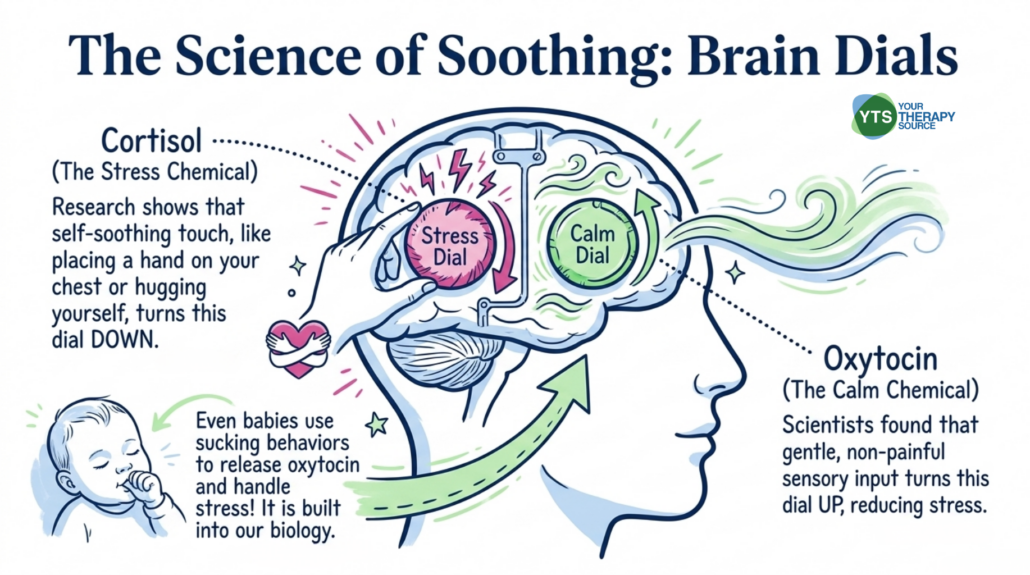
- In a randomized controlled trial with 159 healthy adults, self-soothing touch, such as placing a hand on the chest, and receiving a hug were both associated with lower cortisol responses to a standardized stress task (Dreisoerner et al., 2021).
- A research review found that non-noxious sensory stimulation, including touch and warmth, may prompt oxytocin release, which is associated with reduced stress and a greater sense of well-being (Uvnäs-Moberg et al., 2015).
- A clinical overview of early childhood sucking behaviors, such as thumb sucking and pacifier use, describes sensory input from sucking as a support for oxytocin release that may help regulate responses to internal and external stressors (Staufert Gutierrez et al., 2026).
It is worth noting that some of this research, including the Dreisoerner et al. (2021) trial, was conducted with adults rather than children. The findings offer a useful window into how touch and sensory input may influence stress, but they should be applied to students with appropriate caution.
EXAMPLES OF EVERYDAY SELF SOOTHING
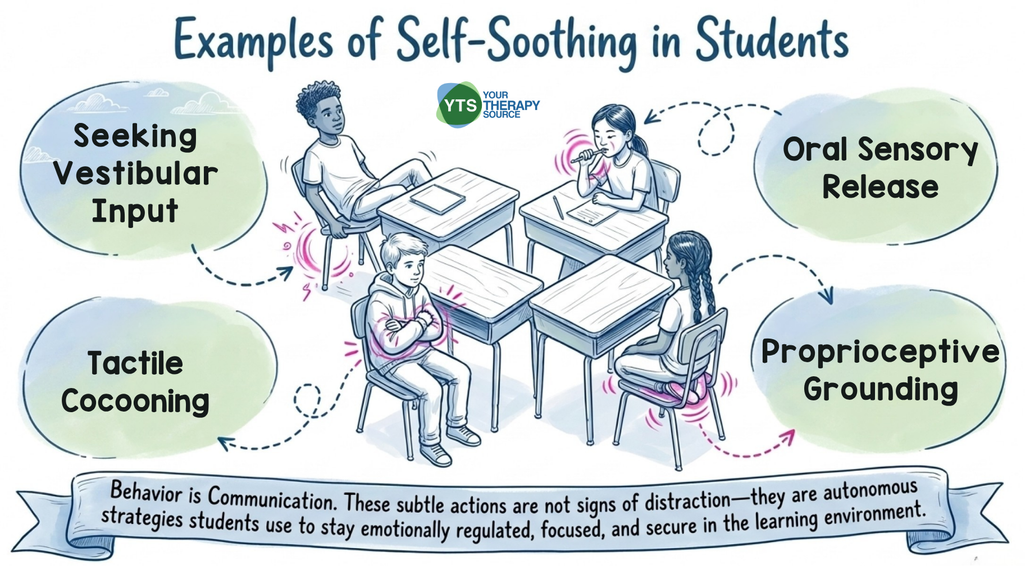
Self soothing behaviors can look different from student to student. Common examples that school staff may already see include the following.
- Placing a hand over the heart or chest
- Wrapping arms around the body or giving oneself a light hug
- Pulling a sleeve down over the hands
- Holding, squeezing, or rubbing a soft object
- Rocking gently or swaying while seated
- Sucking on a thumb, finger, or object in younger children, sometimes referred to as oral stimming
- Wrapping up in a blanket or weighted item
- Taking slow, deep breaths
These behaviors are common in both neurotypical and neurodivergent children. They are a normal part of how the nervous system manages stress and are not, on their own, a sign of a problem.
DIFFERENCE BETWEEN SELF SOOTHING AND STIMMING
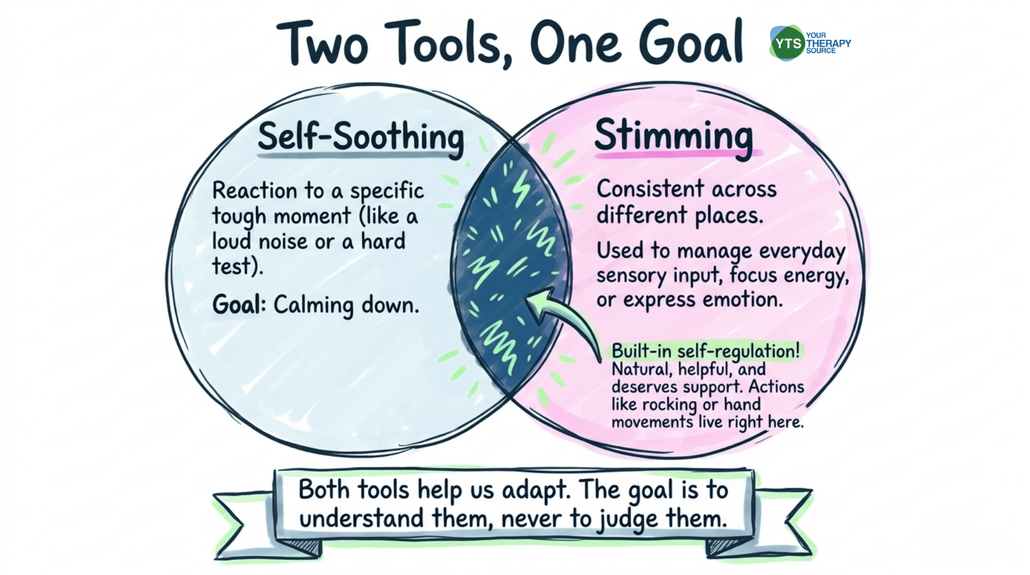
Self soothing and stimming can look similar and often overlap, so it helps to think about them without ranking one as more acceptable than the other. Both are natural forms of self regulation, and both deserve to be supported rather than stopped.
- Self soothing is generally understood as a response to a specific stressor, such as a test, a loud noise, or a difficult transition.
- Stimming, or self-stimulatory behavior, may occur more consistently across settings and is commonly used by neurodivergent individuals, including autistic students, to manage sensory input, focus, or emotion. A closer look at common stimming behaviors can help staff recognize the range of ways this shows up in the classroom.
- Some behaviors, such as rocking or hand movements, can serve either function depending on the individual and the situation.
Foster (1998) found that nervous habits and motor stereotypies, such as thumb sucking and body rocking, are common among typically developing preschool children and appear related to mood state. A neuroaffirming approach recognizes that both self soothing and stimming can be adaptive, and the goal for school staff is to understand the function of a behavior rather than judge its appearance.
HOW TO SUPPORT STUDENTS IN THE CLASSROOM USING SELF SOOTHING TO HELP WITH SELF REGULATION
School staff can take a supportive, non-judgmental approach to self soothing behaviors. The following considerations may help guide classroom practice.
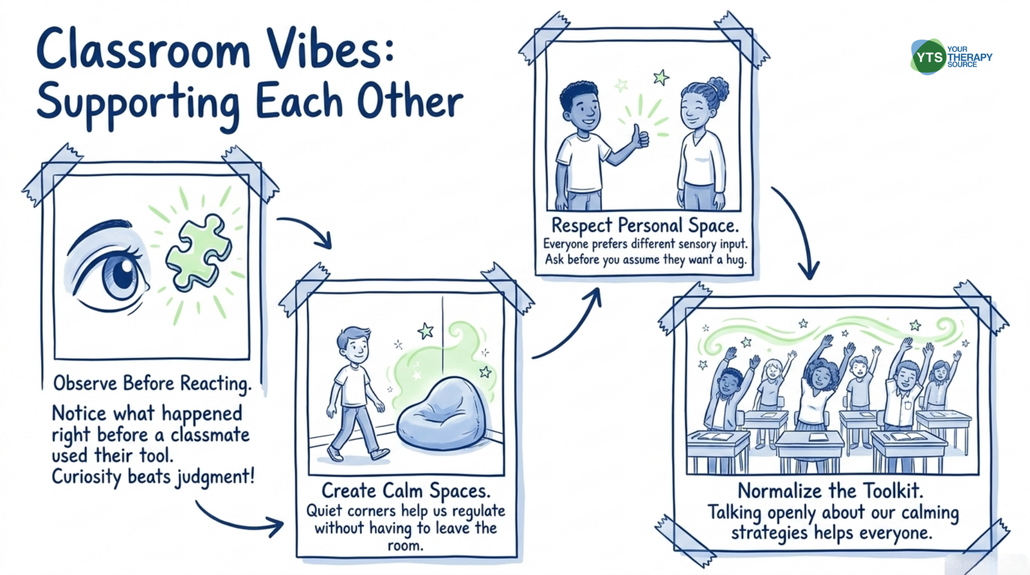
- Observe before responding. Notice when a student uses a self-soothing behavior and what happens right before it. This can help staff understand what the behavior may be helping the student manage.
- Avoid stopping the behavior automatically. Unless a behavior is unsafe or disruptive to others, consider letting it continue. Interrupting self soothing may remove a tool the student needs.
- Offer sensory options. Items such as fidget tools, textured fabric, or a small pillow can give students an accessible way to self soothe during the school day.
- Normalize self soothing for the whole class. Talking openly about calming strategies helps all students, not just those who are struggling, and reduces stigma.
- Build in movement breaks. Short breaks for stretching, walking, or gentle rocking may support students who use movement to regulate.
- Create a calm corner or quiet space. A designated area with soft materials or dim lighting gives students a place to self soothe without leaving the classroom.
- Coordinate with related service providers. Occupational therapists and other specialists can help identify which self-soothing supports may work best for an individual student.
- Respect personal space and preferences. Some students may prefer deep pressure, while others prefer light touch or no touch at all. Ask or observe rather than assume.
- Watch for changes in the behavior. A shift in frequency or intensity of self soothing may be worth noting and sharing with the school team, without assuming a cause.
- Model calm behavior. Adults who use visible self-regulation strategies, such as slow breathing, can help normalize these tools for students.
CONCLUSION
Research on self soothing suggests that simple, self-directed behaviors involving touch and sensory input may help lower stress and support emotional regulation. While much of this research comes from studies with adults or young children, the underlying idea, that the body has built-in ways to seek calm, is relevant to students of all ages in school settings.
For school-based teams, this means approaching self soothing and stimming with curiosity rather than correction. Leaning on neurodiversity-affirming practices can help staff view these behaviors as part of a student’s self regulation toolkit, supporting participation, comfort, and learning throughout the school day.
REFERENCES
Dreisoerner, A., Junker, N. M., Schlotz, W., Heimrich, J., Bloemeke, S., Ditzen, B., & van Dick, R. (2021). Self-soothing touch and being hugged reduce cortisol responses to stress: A randomized controlled trial on stress, physical touch, and social identity. Comprehensive Psychoneuroendocrinology, 8, 100091. https://doi.org/10.1016/j.cpnec.2021.100091
Foster, L. G. (1998). Nervous habits and stereotyped behaviors in preschool children. Journal of the American Academy of Child and Adolescent Psychiatry, 37(7), 711-717. https://doi.org/10.1097/00004583-199807000-00010
Staufert Gutierrez, D., Daley, S. F., & Carugno, P. (2026). Thumb sucking and other nonnutritive sucking habits in children. In StatPearls. StatPearls Publishing. https://www.ncbi.nlm.nih.gov/books/NBK556112/
Uvnäs-Moberg, K., Handlin, L., & Petersson, M. (2015). Self-soothing behaviors with particular reference to oxytocin release induced by non-noxious sensory stimulation. Frontiers in Psychology, 5, 1529. https://doi.org/10.3389/fpsyg.2014.01529

