
Self-Injurious Behaviors In Young Autistic Children
Self-injurious behaviors in young autistic children, such as head banging, self-biting, and skin picking, are more common than many school teams realize. Research estimates that up to half of autistic individuals experience these behaviors at some point in their lives. For educators and therapists, these behaviors can affect a child’s safety, learning, and ability to participate in classroom activities. You can download a printable at the bottom of the post to support your students too!
A recent longitudinal study from the UC Davis MIND Institute followed autistic children from the preschool years into early school age to better understand how self-injurious behaviors change over time and what factors are associated with those changes (Boyle et al., 2026). The findings offer school-based professionals helpful context for observing and supporting young students.
WHAT THE RESEARCH EXAMINED
The study looked at how common self-injurious behaviors (SIBs) were in young autistic children and whether cognitive ability, sensory features, or emotional and behavioral dysregulation were related to how severe those behaviors were over time. Caregivers completed standardized questionnaires, and children were grouped by their most severe reported behavior: no SIB, mild, moderate, or severe.
Key study details included:
- 325 autistic children were assessed at ages 2 to 5 years, and 161 were assessed at ages 4 to 9 years, including 122 children evaluated at both time points
- Researchers measured developmental or intellectual ability, sensory features, and broad emotional and behavioral dysregulation at each time point
- The study used caregiver-report tools, including the Repetitive Behaviors Scale-Revised, the Short Sensory Profile, and the Child Behavior Checklist
KEY FINDINGS FROM THE RESEARCH
Overall, self-injurious behaviors were highly common in this group of young autistic children, and individual children often shifted between severity levels over time.
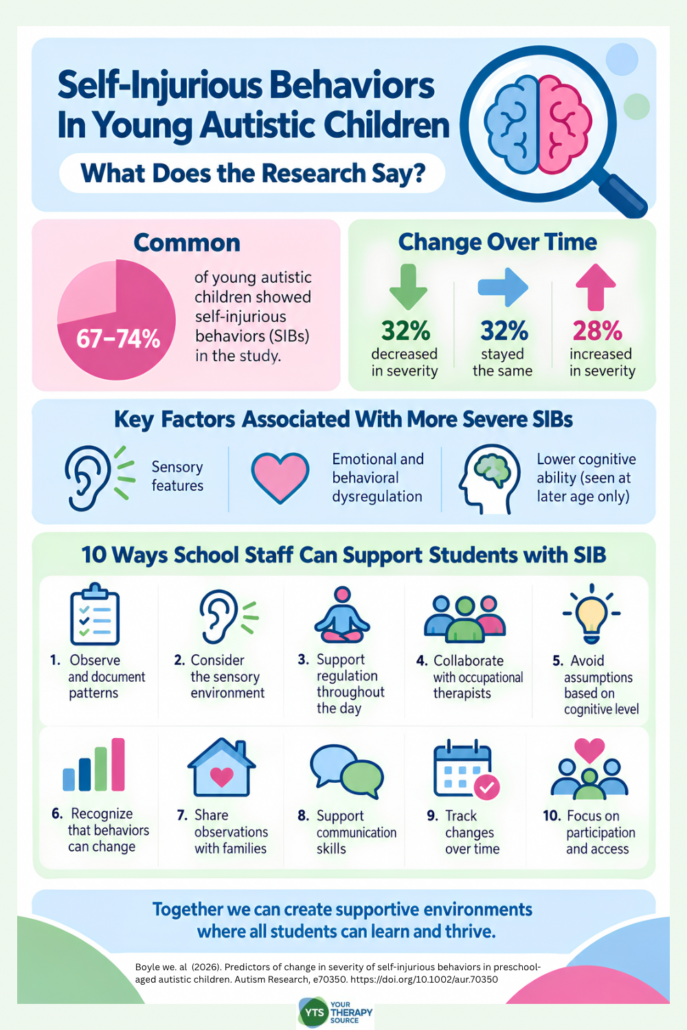
- At the first time point, 74% of children showed some form of SIB. At the second time point, 67% did. Only 9% of children with data at both time points showed no SIBs at either point.
- At both time points, children with more severe SIBs tended to have more pronounced sensory features and greater emotional and behavioral dysregulation.
- Differences in cognitive ability appeared only at the later time point, where children with moderate or severe SIBs had, on average, lower IQ scores than children with no SIBs.
- Early scores on sensory, dysregulation, and cognitive measures did not predict which children would increase or decrease in SIB severity later on.
- However, children whose sensory features improved over time, and children with higher IQ at the later time point, were more likely to show decreasing SIB severity.
- Severity was not fixed. About 32% of children decreased in SIB severity over time, about 28% increased, and about 32% stayed the same.
Because this was a natural history study, these results describe associations rather than cause and effect.
WHY THESE FINDINGS MATTER FOR SCHOOL-BASED PRACTICE
Many autistic students enter preschool and early elementary classrooms during the exact age range studied here, so these findings are directly relevant to school teams.
- SIBs are common, not rare, in young autistic children, which means school staff are likely to encounter them and benefit from understanding them.
- Sensory features and dysregulation were consistently associated with SIB severity, which highlights the value of paying attention to a child’s sensory responses and regulation in the school environment.
- SIB severity changed substantially for many children over just two to three years, which suggests these behaviors are dynamic rather than permanent.
Understanding the connection between sensory processing and learning can help teams observe students more thoughtfully and share more useful information during team meetings.
IMPLICATIONS FOR SCHOOL STAFF
These findings suggest that school staff can play an important role by observing patterns and sharing information with families and related service providers, rather than assuming SIBs reflect a fixed trait of the child.
Staff may notice that students with more severe SIBs also show:
- Strong reactions to sensory input, such as sounds, textures, or lights, or reduced responses to sensory input
- Difficulty calming after becoming upset, or frequent shifts in emotional and behavioral regulation
- Behaviors that vary in intensity across settings, days, or school years
Because improvements in sensory features were associated with decreasing SIB severity over time, a whole-team approach that considers the sensory environment, regulation supports, communication, and overall development may be the most helpful frame. Physical wellbeing matters too, as ongoing research on autism and the gut reminds us that comfort and health can influence how a child regulates and participates. Occupational therapists, teachers, and families each contribute different observations, and combining them gives the team a fuller picture of the child.
10 PRACTICAL STRATEGIES OR CONSIDERATIONS
- Observe and document patterns. Note when, where, and under what conditions self-injurious behaviors occur. Patterns related to noise, transitions, demands, or fatigue can give the team useful information to discuss together.
- Consider the sensory environment. Since sensory features were associated with SIB severity in this study, teams may want to review classroom lighting, sound levels, seating, and crowding. Understanding areas such as visual processing and autism can guide small environmental adjustments that make the setting more comfortable for some students.
- Support regulation throughout the day. Predictable routines, calm spaces, and planned breaks may help students manage arousal before it escalates. Building regulation supports into the schedule is often easier than responding after a student is already overwhelmed.
- Collaborate with occupational therapists. OTs can help teams understand a student’s sensory responses and identify supports that fit the classroom. Their observations pair well with teacher data about when behaviors occur.
- Avoid assumptions based on cognitive level. In this study, early developmental scores did not distinguish SIB severity groups, and children across a wide range of abilities showed SIBs. Every student deserves careful observation rather than assumptions.
- Recognize that behaviors can change. Many children in the study moved between severity levels over two to three years. Teams can revisit supports regularly instead of treating a student’s current behavior as permanent.
- Share observations with families. Caregivers completed the measures in this research, which is a reminder that families hold essential information. Regular two-way communication helps everyone track changes across home and school.
- Support communication skills. The study authors note that supporting communication, alongside sensory and regulation supports, may be part of a broader approach to reducing SIBs over development. Helping students express needs and discomfort supports participation across the school day.
- Track changes over time. Because severity shifted for many children, simple ongoing data collection can help teams notice whether behaviors are increasing, decreasing, or staying stable. This information supports thoughtful team decision-making.
- Focus on participation and access. SIBs can be a barrier to social and school participation. Framing supports around helping the student access learning, peers, and activities, including building motor skills and independence in autism, keeps the team centered on function rather than on the behavior alone.
CONCLUSION
This research suggests that self-injurious behaviors are common in preschool-aged autistic children and that severity often changes between the preschool and early school years. Sensory features and emotional and behavioral dysregulation were consistently associated with SIB severity, and improvements in sensory features over time were linked with decreasing severity.
For school-based professionals, these findings support careful observation, attention to sensory and regulation needs, and ongoing collaboration with families and related service providers. Viewing these behaviors as dynamic rather than fixed can help teams stay flexible, revisit supports regularly, and keep the focus on each student’s participation and learning.
REFERENCES
Boyle, J., Dakopolos, A., Surgent, O., Lee, J. K., Andrews, D. S., Heath, B., Smucny, J., Solomon, M., Rogers, S. J., & Nordahl, C. W. (2026). Predictors of change in severity of self-injurious behaviors in preschool-aged autistic children. Autism Research, e70350. https://doi.org/10.1002/aur.70350
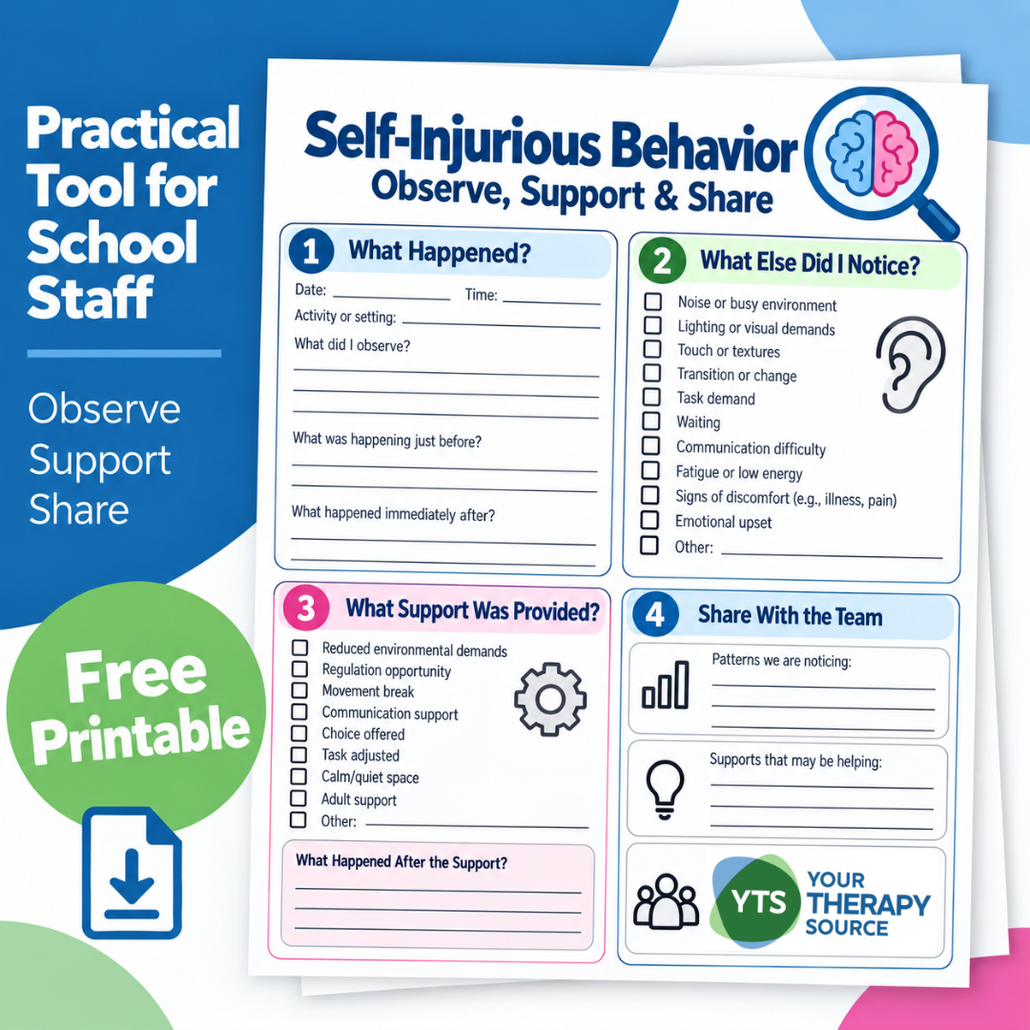
FREE SELF-INJURIOUS BEHAVIOR OBSERVATION PRINTABLE
To help school teams put these ideas into practice, download the free Self-Injurious Behavior: Observe, Support & Share printable at the bottom of this post. This one-page tool gives teachers, therapists, and other school staff a simple way to document observations and share useful information with the team.
The printable includes space to record:
- What happened before, during, and immediately after the behavior
- Environmental, sensory, communication, regulation, and other factors staff noticed
- Supports that were provided
- What happened after the support was provided
- Patterns the team is noticing over time
- Supports that may be helping
- Questions to discuss with families and other team members
The goal is observation rather than assumption. Because the research found that SIB severity can change over time and that sensory features and emotional and behavioral dysregulation were associated with severity, ongoing observations may help teams identify changes and have more informed discussions about student supports (Boyle et al., 2026).
This printable is not intended to determine the cause or function of self-injurious behavior. It can be used as one source of information within a broader team approach that considers communication, sensory needs, regulation, health and comfort, environmental demands, and participation.
CREATE AN ACTION PLAN TO SUPPORT YOUR STUDENTS
Observations are helpful, but school teams also need a practical plan for what to do next. The YTS Action Toolkit helps educators and therapists turn student needs and team observations into clear, individualized action plans with strategies that can be used throughout the school day.
Use the Action Toolkit to help:
- Identify practical supports based on the student’s needs
- Create clear strategies for teachers, therapists, and support staff
- Develop consistent approaches that can be shared across the team
- Turn observations into actionable next steps
- Adjust supports as student needs change over time
The goal is to make it easier for teams to move from “What are we noticing?” to “What can we try next?” while keeping the focus on participation, regulation, access, and student success.
Explore the YTS Action Toolkit
DOWNLOAD YOUR FREE PRINTABLE HERE
Enter your email below and you will be redirected to the free printable.
