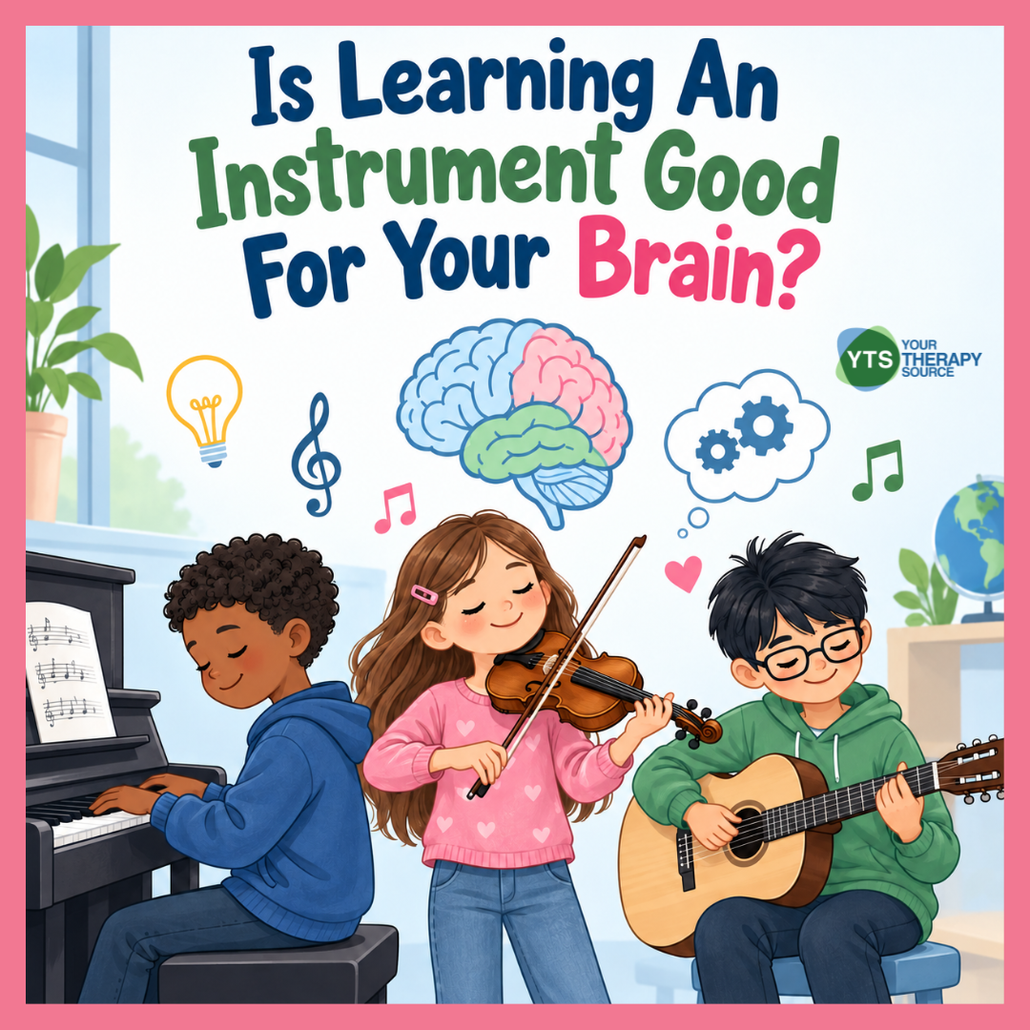
Is Learning An Instrument Good For Your Brain?
Many children take piano, violin, or guitar lessons after or during school. Families and school staff often ask: is learning an instrument good for your brain? This question matters in schools, where music programs often compete for time and funding. A 2026 study compared children ages 7 to 9 who regularly practiced an instrument with children who did not. The results show links between playing an instrument, thinking skills, and school achievement. The study also looked at brain structure, although that part of the evidence is less certain.
WHAT THE RESEARCH EXAMINED REGARDING IS LEARNING AN INSTRUMENT GOOD FOR YOUR BRAIN?
The researchers wanted to know whether playing an instrument was linked to thinking skills, academic skills, and brain structure in middle childhood. They used existing data from a larger physical activity study in Illinois. No music lessons were given as part of this research.
Study snapshot:
- The study included 76 children ages 7 to 9. Half played an instrument and practiced more than 30 minutes a week, based on a caregiver questionnaire. The other half did not play an instrument. The two groups were matched by age, sex, and socioeconomic status, and piano was the most common instrument.
- Children completed standardized tests of thinking skills, working memory, and academic achievement in reading, spelling, math, writing, and listening.
- A smaller group of 50 children (25 in each group) had brain scans. The scans focused on the arcuate fasciculus, a pathway that connects brain areas linked to language and sound.
KEY FINDINGS FROM THE RESEARCH
Children who played an instrument scored higher than children who did not on several tests of thinking and academic skills. The brain imaging results were less clear.
What the researchers found:
- The music group scored higher on broad measures of thinking ability, including general intelligence and reasoning scores.
- The music group also scored higher on specific tasks involving spatial skills, word knowledge, learning new symbols, and working memory.
- In academics, the music group scored higher on overall achievement and on reading, reading fluency, math, and written language scores. Specific skills with higher scores included word reading, decoding, reading comprehension, spelling, and math concepts.
- Some areas showed no clear difference between groups. These included planning, visual scanning tasks, sound blending, repeating numbers backward, and math computation.
- Brain scans showed a difference in one measure of the right arcuate fasciculus in the music group. However, this result did not remain significant after the researchers adjusted for testing many measures, so it should be viewed as tentative. No differences were found on the left side.
WHY THESE FINDINGS MATTER FOR SCHOOL-BASED PRACTICE
Reading, writing, math, and working memory all affect how students take part in the school day. The study suggests that regular instrument practice is associated with stronger performance in several of these areas.
Standout points for school teams:
- The links reached beyond music into reading, spelling, and math concepts, which are core parts of classroom learning.
- Working memory scores were higher in the music group. Working memory helps students follow multistep directions, do mental math, and hold onto ideas while writing.
- The study design cannot show that music caused these differences. In their discussion, the authors note that broader family enrichment and involvement in other activities may also play a role.
Music can also connect to other parts of the school day, such as understanding feelings, as described in this look at music and emotions.
IMPLICATIONS FOR SCHOOL STAFF
The findings suggest that music experience may be one of many factors connected to learning. They also show that students do not all have the same access to lessons and instruments.
What staff might notice:
- Students vary widely in their music experience, and the cost of lessons and instruments can limit access for some families.
- Students who practice an instrument regularly may already have a lot of experience reading symbols, listening closely, and repeating a sequence.
- For some students, classroom songs, rhythm games, or background music may be their only regular music experience.
Music works best as one part of a multi-modal approach that also includes movement, sensory supports, and predictable routines. Staff can think of music as a tool that supports participation rather than a stand-alone solution. For students who need extra help with attention, ideas for supporting students with ADHD using music can fit within this broader approach.
IS LEARNING AN INSTRUMENT GOOD FOR YOUR BRAIN: 10 PRACTICAL STRATEGIES
- Build Rhythm Into Daily Routines. Clapping or tapping patterns during transitions ask students to listen, remember, and repeat a sequence. These short activities may support working memory and classroom participation.
- Use Songs to Teach Multistep Directions. Setting classroom steps to a simple tune can make directions easier to remember. This may help students who have trouble holding several steps in mind.
- Pair Music With Early Reading Skills. Clapping syllables or singing rhyming words connects sound patterns to reading. These activities fit easily into literacy lessons.
- Support Access to Instruments. The authors suggest that schools make instruments more available and reduce costs for families. Teams can look into lending programs, donated instruments, or partnerships with community music groups.
- Offer Simple Classroom Instruments. Shakers, drums, and rhythm sticks invite students to use both hands together and control their movements. These tools can support fine motor skills, gross motor skills, and bilateral coordination.
- Connect Music to Body Awareness. Noticing how fast or slow music feels in the body can help students tune in to their own internal signals. Learn more about music and interoception and how it may relate to self-regulation.
- Use Calming Music During Quiet Tasks. Soft background music during independent work may help some students settle and stay focused. Options like quiet calming music for classroom coloring pages pair music with a low-demand activity.
- Practice Symbol Learning Through Music. Color-coded notes or simple picture-based rhythm charts ask students to match symbols to sounds. This connects to visual perceptual skills and the symbol-learning tasks measured in the study.
- Collaborate With Music Educators. Music teachers can share activities that already support listening, sequencing, and motor control. Working together helps therapists and teachers extend these skills across the school day.
- Keep Expectations Realistic. The study showed links, not proof that music causes better learning. Music activities work best alongside other supports and are not a replacement for targeted instruction.
CONCLUSION
This study found that children ages 7 to 9 who regularly played an instrument scored higher on several tests of thinking skills, working memory, and academic achievement than matched peers who did not. A possible brain difference was also found, but it did not hold up after statistical adjustment and should be viewed with caution.
For school teams, these findings support treating music as a valuable part of a well-rounded school day. Thoughtful use of rhythm, songs, and instruments, along with attention to fair access, can help music support participation and learning for all students.
REFERENCE
Lopez, K. L., Chen, Y., Burtonpatel, R., Raine, L., Kramer, A. F., Hillman, C. H., & Loui, P. (2026). Musical training is associated with cognitive outcomes and white matter microstructure in middle childhood. Developmental Cognitive Neuroscience, 81, 101813. https://doi.org/10.1016/j.dcn.2026.101813