
How to Help Students Follow Multistep Directions
A student who has trouble following multi-step directions may complete the first step, forget what comes next, or ask for help immediately after instructions are given. These moments can interrupt classroom routines, but they also provide clues about the support a student needs. Learn more about how to help students follow multistep directions.
Following directions involves understanding language, holding information in mind, managing distractions, and carrying out actions in the correct order. Research offers practical insights into how teachers and therapists can adjust instruction to support these demands. Be sure to download the free two-page Following Multi-Step Directions printable at the bottom of this blog post.
What the Research Examined
Recent research has explored how working memory, language complexity, distractions, and different ways of responding to instructions affect children’s ability to follow directions. Studies have also examined classroom supports, children’s memory strategies, and digital activity schedules.
The research includes controlled experiments, a classroom intervention, and a systematic review. An earlier study comparing mental imagery with verbal rehearsal also provides useful information about helping children remember spoken instructions.
Key Findings From the Research
A classroom study involving 67 children ages 6–12 found that teachers and parents reported fewer working-memory-related difficulties following a tailored instructional support intervention. Teachers received training and coaching in feedback, prompting, rules, modeling, and critical thinking strategies (Sankalaite et al., 2025).
Verbal working-memory test performance did not significantly improve. The findings suggest that instructional changes may help students manage everyday demands without a measurable increase in verbal working-memory capacity. However, the study was small, and teachers both delivered the intervention and rated classroom outcomes (Sankalaite et al., 2025).
A study of 63 children ages 7–10 found that children used different strategies during working-memory tasks. Strategy use was generally associated with stronger performance, but the relationships varied across tasks. Because the study examined associations, it does not establish that teaching a particular strategy causes improvement (Hrysanidis et al., 2026).
In a study of 146 children ages 7–12, imagining the actions helped children recall spoken instructions better than verbally rehearsing them. This supports offering “picture yourself doing it” as an option to try, while recognizing that the study used a controlled instruction task (Yang et al., 2021).
Another experiment found that competing tasks interfered with children’s instruction recall. Children performed better when carrying out the instructed actions than when verbally repeating the instructions, showing that saying the steps and doing them place different demands on students (Makri & Fiske, 2023).

Why These Findings Matter for School-Based Practice
These findings give school staff a reason to look closely at how directions are delivered. When a student misses a step, repeating the entire instruction may not address the specific difficulty.
For example, a teacher says, “Get your notebook, write the date, and answer the first question.” One student gets the notebook but forgets the remaining steps. Another remembers the words but does not understand which question to answer. A third misses the instruction while putting away supplies.
Each situation suggests a different support to try. The first student could use a visible list, the second may need the teacher to point out the question, and the third may need the direction given after the supplies are put away. These are practical examples of matching support to an observed difficulty.
Teachers and parents reported fewer working-memory-related difficulties after teachers used tailored instructional supports, although verbal working-memory test performance did not significantly improve (Sankalaite et al., 2025). For school teams, this supports trying practical changes to instruction and monitoring whether they help students complete everyday routines.
For additional examples, explore these ideas for supporting following directions.
Implications for School Staff
Begin by noticing where the difficulty occurs. Does the student miss the instruction, start the wrong action, skip a middle step, or finish the assignment but forget to hand it in?
Notice successful attempts too. A student may manage a familiar routine independently but need support when the wording, materials, or expectations change.
Choose one classroom routine and try one manageable adjustment. Record whether the student completes more steps, needs fewer reminders, or asks more specific questions.
If difficulties persist across activities, share these observations with the school team. They can guide discussion about language, attention, hearing access, learning needs, and other barriers to participation.
Is the Problem the Number of Steps or the Language?
Counting steps does not capture everything a direction requires. The vocabulary, sentence structure, and familiarity of the task also deserve attention.
Consider these two examples:
“Before you put your notebook away, circle the answer you want to share.”
“Circle your answer. Then put your notebook away.”
Both involve similar actions, but the second states them in the order they should happen. This may make the sequence easier for a student to interpret.
A study of children ages 3–5 found that comprehension and response speed varied across different types of sentences containing “because” and “if” (Lemen et al., 2024). It provides relevant background about language demands, but it did not test the notebook example or whether rewriting classroom directions improves performance.
Check whether students understand the action words and concepts in a direction. Words such as “compare,” “underline,” and “alternate” may require teaching or demonstration.

Can Students Picture Themselves Following the Directions?
For some students, imagining an action may help them remember what to do. Research comparing mental imagery with verbal rehearsal offers direct support for trying this approach with school-age children (Yang et al., 2021).
For example, after hearing “Put your book in your backpack,” a student might briefly imagine picking up the book and placing it inside. For a short sequence, the student can try imagining the actions in order.
Keep this optional and concrete. If a student finds mental imagery confusing or unhelpful, try a visible list, demonstration, or another support instead.
Visual Supports Should Match the Student and the Task
A visual support gives students something to consult after spoken instructions have ended. Depending on the student, this could be a short written list, photographs, drawings, or a completed example.
Research on digital activity schedules offers useful information, but its limits matter. A systematic review included 17 studies and 58 participants with autism or intellectual disability, and many studies combined schedules with other interventions. Only 41% met the specified quality indicators (Hammond et al., 2025).
This review examined digital schedules for moving through activities and excluded task analyses of a single activity. Its findings therefore do not directly establish the effectiveness of a paper checklist for completing steps within one classroom task.
A practice article provides guidance for designing, implementing, and monitoring visual activity schedules. It emphasizes a planned teaching process, rather than simply placing a schedule near the student (Tuck et al., 2024).
In the classroom, show students how to find the current step, complete it, and return to the plan. Keep the support accessible and check that the student understands its words or pictures.
When and How to Use the Free Following Multi-Step Directions Printables
The free download includes two black-and-white pages designed for 8.5 × 11-inch printing. Use them together or choose the page that fits the student’s current needs.
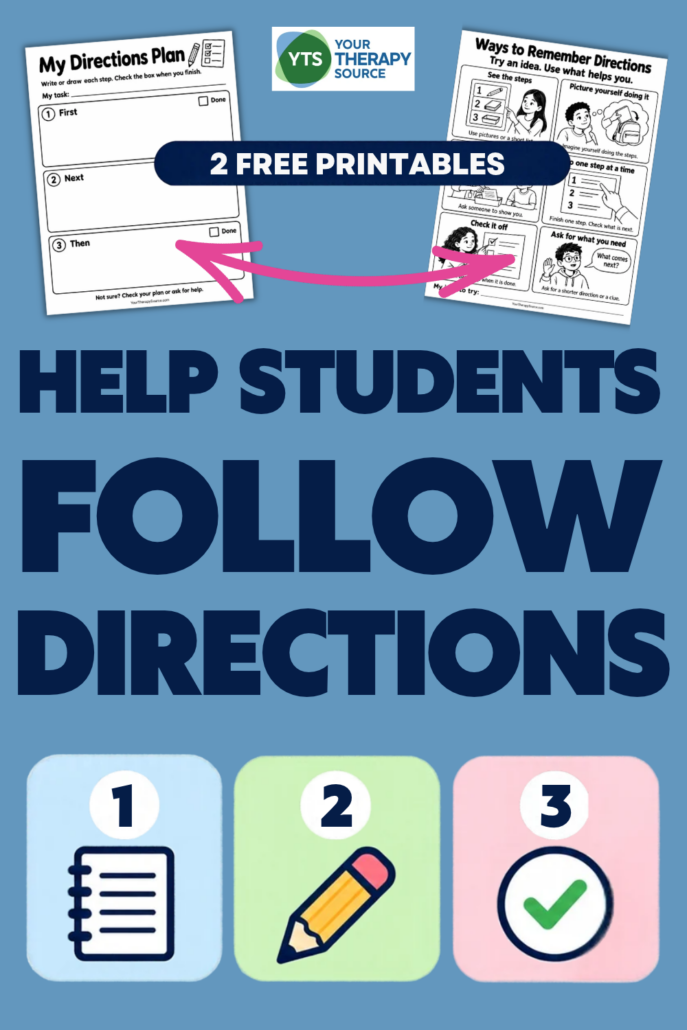
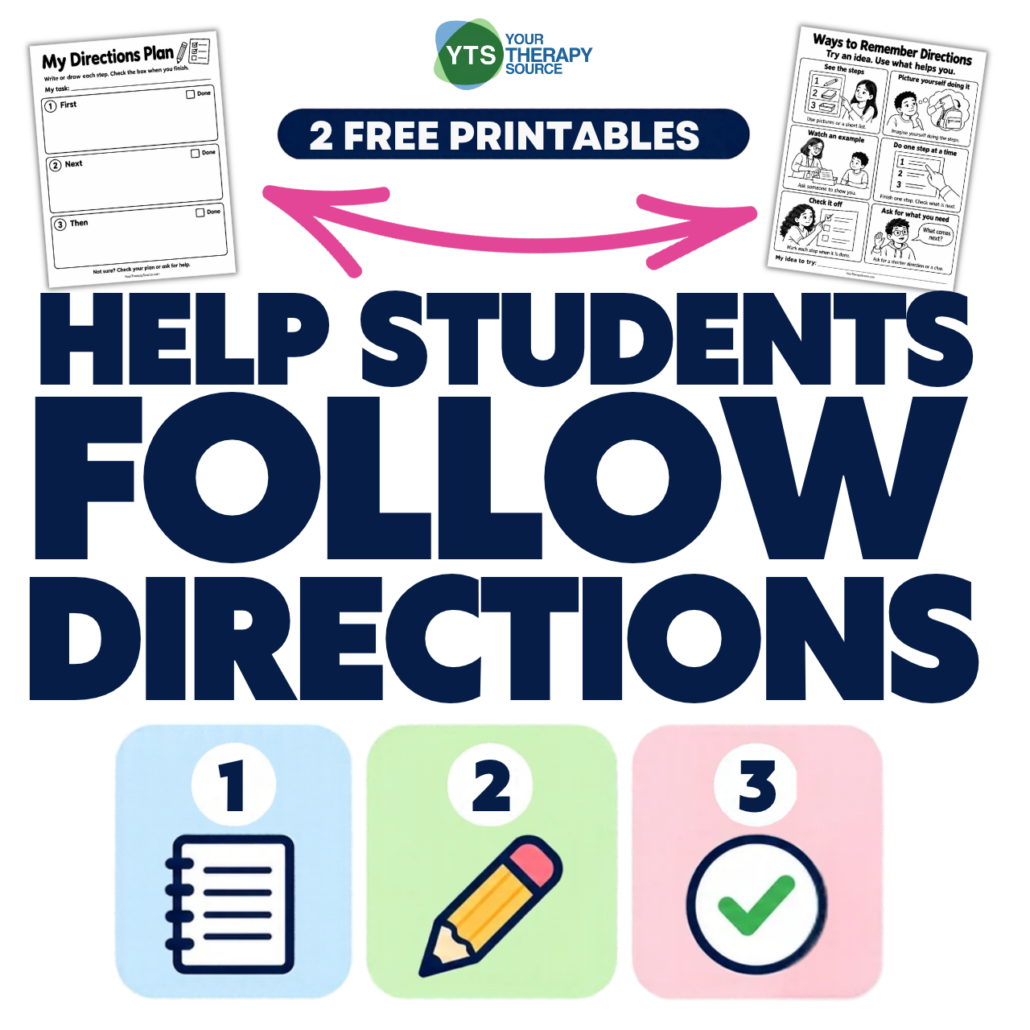
My Directions Plan includes three large spaces labeled First, Next, and Then, with a Done checkbox for each step. Students and adults can write or draw the steps for a classroom activity.
Start with a familiar task, such as preparing materials or completing and handing in work. Model checking the plan after each action, and use fewer than three spaces when appropriate.
Ways to Remember Directions provides six illustrated ideas: see the steps, picture yourself doing it, watch an example, do one step at a time, check it off, and ask for what you need. Students can select an idea to try using the space at the bottom.
These are research-informed options, not six strategies that have all been independently proven to improve memory. Mental imagery has direct experimental support, while other suggestions draw on broader instructional approaches or provide practical ways to track progress and request help.
The pages are classroom tools rather than standardized assessments or a tested intervention program. Observe how the student uses them and adjust the support accordingly.
YTS Action Toolkit Annual License
Turn complex challenges into clear, ready-to-use next steps.
10 Practical Strategies or Considerations
- Establish readiness before giving directions. Use a familiar attention cue and check that students can access the instruction. Avoid beginning while they are managing another demanding task.
- State actions in the order they should happen. Use clear wording and separate background explanations from the immediate steps when helpful.
- Adjust the amount of information. If a student repeatedly loses part of a sequence, try a shorter section of the task and observe whether performance changes.
- Clarify unfamiliar words. Teach or demonstrate action words and concepts. Reducing the number of steps will not resolve a direction the student does not understand.
- Make the steps visible. Offer a short list, pictures, or the My Directions Plan page. Match the format to the student’s reading and communication needs.
- Offer mental imagery as an option. Invite the student to picture performing a familiar action. Continue only if the strategy is understandable and helpful.
- Show an example. Demonstrate an unfamiliar action or the use of the directions plan. Let the student see what the expected step looks like.
- Teach students to track their place. Model completing one step, checking it off, and locating the next step. Keep useful visual supports available as adult prompting decreases.
- Make clarification easy. Practice a specific request such as “What comes next?” or “Can you show me?” This gives students a way to seek the information they need.
- Practice and monitor real routines. Notice whether the support helps during packing up, preparing materials, or handing in work. These free oral and written directions activities provide additional practice opportunities, but also check for success during everyday classroom activities.
Individualized Support Through the Action Toolkit
Two students who miss the same direction may need different supports. One may benefit from clearer language, another may need visible steps, and another may need help organizing materials before beginning.
Discover How I Learn, available inside the Your Therapy Source Action Toolkit, helps bring the student’s perspective into planning. Its individualized recommendations help teams consider environment changes, skills, habits, and strategies to try.
Use these recommendations alongside classroom observations to develop a manageable action plan. Select a support, try it during a specific routine, and review whether it helps the student participate more independently.
Conclusion
Following multi-step directions involves several demands that can vary from one task to another. Research supports examining these demands and trying supports that match the student and situation. Start with one routine and one useful adjustment. Make the next action clear, provide a way to keep track of the steps, and notice what helps the student move forward.
Download the Free Following Multistep Directions Printables
Get My Directions Plan and Ways to Remember Directions in one free, two-page PDF. Both pages are black and white and ready to print on 8.5 × 11-inch paper. Enter your email below to access the free printables.
References
Hammond, A. W., Morris, J. R., Gabrielsen, T., Smith, T. B., & Medsker, N. (2025). A systematic review of digital activity schedule use in individuals with autism spectrum disorder and intellectual disability. Journal of Intellectual & Developmental Disability, 50(4), 502–516. https://doi.org/10.3109/13668250.2025.2499009
Hrysanidis, C., Lau, R. C., Anderson, P. J., Ramirez Herrera, L., Gathercole, S., Wiley, J. F., & Spencer-Smith, M. (2026). Working memory strategies in children aged 7–10 years. Memory & Cognition. Advance online publication. https://doi.org/10.3758/s13421-026-01916-z
Lemen, H. C. P., Lieven, E. V. M., & Theakston, A. L. (2024). The influence of pragmatic function on children’s comprehension of complex because- and if-sentences. Frontiers in Language Sciences, 3, Article 1420237. https://doi.org/10.3389/flang.2024.1420237
Makri, A., & Fiske, A. (2023). Actions versus words: Exploring the contributions of working memory and motoric coding in children’s instruction following using a dual-task paradigm. British Journal of Developmental Psychology, 41(4), 400–411. https://doi.org/10.1111/bjdp.12461
Sankalaite, S., Pollé, S., Huizinga, M., Van der Oord, S., Rakickiene, L., & Baeyens, D. (2025). Supporting children’s working memory through instructional support in primary school: A microtrial study. Education Sciences, 15(10), Article 1379. https://doi.org/10.3390/educsci15101379
Tuck, K. N., Chow, J. C., Kim, G. Y., Malone, E. J., & Smith, K. H. (2024). Implementing visual activity schedules to support elementary student engagement. Beyond Behavior, 33(3), 147–158. https://doi.org/10.1177/10742956241287093
Yang, T.-X., Allen, R. J., Waterman, A. H., Zhang, S.-Y., Su, X.-M., & Chan, R. C. K. (2021). Comparing motor imagery and verbal rehearsal strategies in children’s ability to follow spoken instructions. Journal of Experimental Child Psychology, 203, Article 105033. https://doi.org/10.1016/j.jecp.2020.105033
