Co-Regulation in the Classroom: Supporting the Adults Who Support Students
When students become overwhelmed, frustrated, or emotionally dysregulated, we often focus on strategies to help them manage their emotions and behavior. However, an important part of co-regulation in the classroom is understanding how our own thoughts, emotions, and behaviors influence our interactions with students.
Whether it is a typical school day, a particularly challenging afternoon, or a busy week leading up to the holidays, adults need emotional regulation support, too. Recent research provides insight into how educators can develop strategies that may benefit both their own emotional well-being and their interactions with students.
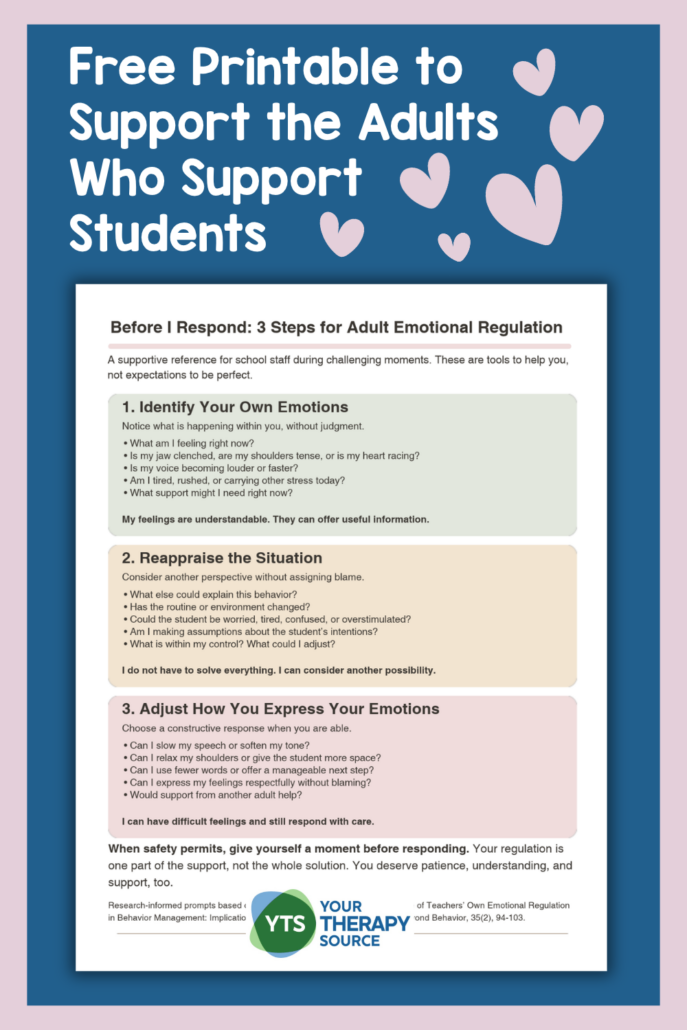
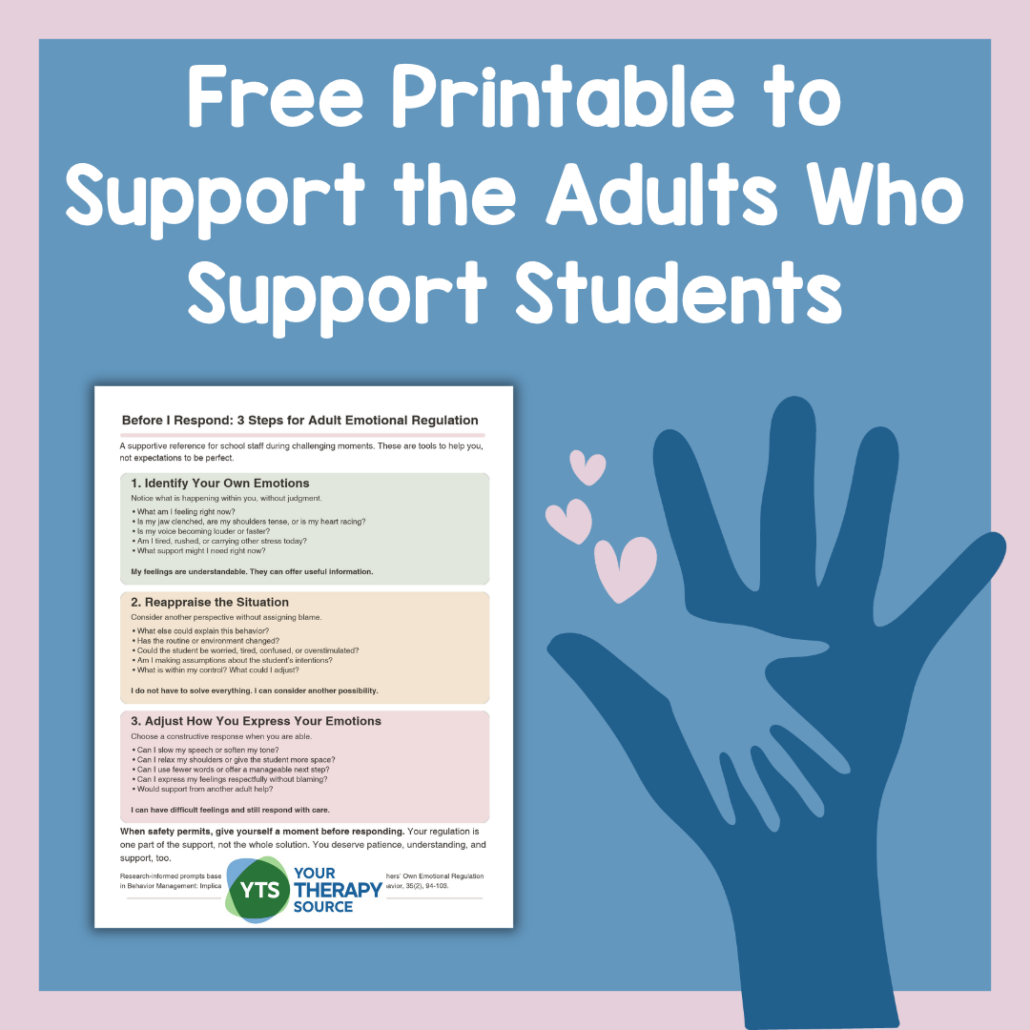
You can download a free Before I Respond reference sheet at the bottom of this post to help school staff practice three steps for adult emotional regulation.
THIS IS ABOUT SUPPORT, NOT BLAME
School staff navigate countless emotional demands throughout the day. Supporting students with diverse needs while managing classroom expectations, paperwork, staffing challenges, and limited resources can be exhausting. It is understandable that adults experience frustration, stress, and moments of overwhelm, too.
Exploring adult emotional regulation is not about blaming educators for student behavior or suggesting that a calm adult will always result in a calm student. Many factors that influence student behavior are outside an educator’s control.
Instead, it is about looking at challenging situations from a different perspective. By recognizing our own emotional responses and considering alternative interpretations of student behavior, we may discover additional ways to support both ourselves and our students.
The goal is not perfection or remaining calm every moment of the school day. It is about developing practical tools that may make challenging interactions less emotionally demanding for everyone involved. Adults deserve the same patience, understanding, and emotional support that we strive to provide to our students.
WHAT DOES THE RESEARCH TELL US ABOUT ADULT EMOTIONAL REGULATION?
A 2026 article published in Beyond Behavior by Stark and Stoffers explores the important role of educators’ own emotional regulation in responding to challenging student behavior. Drawing on previously published research, the authors explain how teachers’ thoughts, feelings, and behaviors are interconnected and influence their ability to implement evidence-based behavioral strategies.
When educators experience intense emotions such as frustration, anger, guilt, or disappointment, their cognitive load can increase. This can make it more difficult to interpret what a student may be communicating through their behavior, make thoughtful decisions, and remember which strategies to implement. The authors also emphasize that emotional regulation is not simply a skill that adults either possess or lack. It is a competency that can be developed and improved through practice.
HOW OUR THOUGHTS INFLUENCE OUR RESPONSES TO STUDENTS
The authors use the cognitive behavioral therapy triangle to illustrate the relationship between thoughts, emotions, and behaviors. How we interpret a student’s behavior can influence how we feel and, ultimately, how we respond.
Consider a student who repeatedly refuses to begin an assignment.
- One adult might think, “This student knows how to do this. Why are they refusing again?” This interpretation may lead to frustration.
- Another possible interpretation is, “Something may be making it difficult for this student to get started today.” This perspective may encourage curiosity and lead to a different approach.
The student’s behavior has not changed, but the adult’s interpretation has. Our previous experiences, expectations, emotions, and implicit biases can influence these interpretations.
Considering another perspective does not mean that our initial feelings are wrong or that we must excuse inappropriate behavior. It simply provides another opportunity to understand the situation and consider possible solutions.
THREE STEPS TO SUPPORT ADULT COREGULATION IN THE CLASSROOM
Stark and Stoffers recommend three steps that educators can practice to develop their own emotional regulation skills during challenging behavioral interactions. These strategies are also relevant to paraprofessionals, occupational therapists, physical therapists, and other school staff who support students throughout the school day.
1. Identify Your Own Emotions
Before responding to a student, when circumstances allow, recognize what you are experiencing emotionally and physically. Developing this awareness can help you understand how your emotions may influence your response.
Ask yourself:
- What am I feeling right now?
- Is my jaw clenched, are my shoulders tense, or is my heart racing?
- Is my voice becoming louder or faster?
- Am I tired, rushed, or carrying other stress today?
- What support might I need right now?
The authors suggest strategies such as reflective journaling, mindfulness, and developing interoceptive awareness to improve emotional recognition. Recognizing our own internal body signals can help us become more aware of our emotional responses.
Remember that experiencing difficult emotions is a normal part of working in an emotionally demanding profession. Our feelings can provide valuable information about our needs and experiences.
2. Reappraise the Situation
Cognitive reappraisal involves changing how we interpret a situation to influence our emotional response. Rather than relying solely on our initial interpretation of a student’s behavior, we can consider other factors that may be contributing to the situation.
Ask yourself:
- What else could explain this behavior?
- Has something changed in the student’s routine or environment?
- Could the student be tired, worried, confused, or overstimulated?
- Are my expectations appropriate for this particular situation?
- Am I making assumptions about the student’s intentions?
- What is within my control? What could I adjust?
The authors discuss two previous research studies related to cognitive reappraisal and teacher well-being:
- A 2010 survey of 610 teachers found that teachers who reported using cognitive reappraisal strategies also reported less emotional exhaustion.
- A 2016 survey of 1,115 teachers found that cognitive reappraisal was associated with greater teaching satisfaction and lower emotional exhaustion.
Although these findings do not establish cause and effect, they suggest that changing how we interpret challenging situations may be beneficial for educator well-being.
We do not have to solve every problem or identify the exact reason for every behavior. Sometimes, simply considering another possibility can help us approach a difficult situation differently.
3. Adjust How You Express Your Emotions
Adults do not have to pretend that they never experience frustration or disappointment. Appropriately expressing authentic emotions can help build trust and model healthy emotional regulation.
However, when a student is already overwhelmed, responding with anger or visible frustration may further escalate the situation. When possible, consider adjusting your tone of voice, facial expression, body language, and choice of words.
Ask yourself:
- Can I slow my speech or soften my tone?
- Can I relax my shoulders or give the student more space?
- Can I use fewer words or offer a manageable next step?
- Can I express my feelings respectfully without blaming?
- Would support from another adult help?
The authors caution that frequently masking or suppressing emotions can negatively affect educator well-being. The goal is not to hide every emotion but to express emotions in a constructive and professionally appropriate manner.
PRACTICAL EXAMPLES OF CO-REGULATION IN THE CLASSROOM
Co-regulation involves providing supportive interactions and environments that help students manage their emotions and behavior while developing their own regulation skills over time. The following examples illustrate how school staff might consider different perspectives and explore alternative responses during everyday classroom situations.
| Student behavior | Consider another perspective | Possible adult response |
|---|---|---|
| Refuses to begin an assignment | The student may not know how to get started. | Offer to complete the first step together. |
| Repeatedly interrupts during a lesson | The student may be struggling with impulse control. | Provide a visual reminder or an appropriate opportunity to participate. |
| Becomes upset after making a mistake | The student may be experiencing frustration or fear of failure. | Acknowledge the frustration and offer help when the student is ready. |
| Refuses to transition to another activity | The student may need additional processing time or predictability. | Provide a transition warning and explain what comes next. |
| Responds angrily to corrective feedback | The student may be feeling embarrassed or discouraged. | Reduce verbal demands and revisit the conversation privately when appropriate. |
| Repeatedly seeks adult reassurance | The student may be uncertain or worried about making a mistake. | Provide a predictable check-in and encourage manageable steps toward independence. |
| Refuses to attend a holiday assembly | The noise or change in routine may be overwhelming. | Offer alternative seating or access to a quieter space. |
| Becomes overwhelmed during a classroom celebration | The student may need help managing increased stimulation. | Offer a movement break or access to a quieter environment. |
These examples are practical applications of the concepts discussed by Stark and Stoffers, rather than interventions specifically tested in their article. The possible explanations are starting points for reflection, not definitive reasons for a student’s behavior.
Co-regulation does not mean eliminating expectations or boundaries. It also does not mean that every supportive response will immediately help a student regulate. It is one component of a broader approach to supporting students.
10 WAYS SCHOOL STAFF CAN SUPPORT THEIR OWN EMOTIONAL REGULATION
Developing adult emotional regulation skills is an ongoing process. These suggestions are not another checklist of responsibilities for school staff, but rather a collection of strategies to consider when they are helpful and feasible.
- Notice situations that typically trigger your own frustration.
- Check in with your own body signals throughout the school day.
- Recognize when your tone of voice or body language begins to change.
- Give yourself a brief moment before responding when safety permits.
- Consider alternative explanations for student behavior.
- Recognize what is within your control and what is not.
- Adjust environmental or task demands when appropriate.
- Ask another staff member for support when needed.
- Reflect on challenging interactions with a trusted colleague.
- Create opportunities for your own emotional and physical regulation when possible.
Start with one or two strategies that feel manageable. Just as students need time and opportunities to develop regulation skills, adults benefit from practice and support.
THE CONNECTION BETWEEN ADULT EMOTIONAL REGULATION AND TEACHER BURNOUT
Managing challenging student behavior can be emotionally demanding. When educators experience high levels of stress, it can become more difficult to consistently implement supportive, evidence-based behavioral strategies.
This can create a difficult cycle. Educator stress may interfere with effective behavioral responses, potentially contributing to additional challenging student interactions and further educator stress.
Developing emotional regulation skills may help interrupt this cycle. However, individual strategies alone cannot address all the factors that contribute to educator stress and burnout.
Educators need adequate resources, realistic expectations, supportive colleagues, and administrative support. Read more about preventing teacher burnout and supporting the well-being of school staff.
HOW SCHOOL LEADERS CAN SUPPORT CO-REGULATION IN THE CLASSROOM
The authors emphasize that supporting educator emotional regulation should not be solely an individual responsibility. School leaders can provide professional development, opportunities for reflection, collaborative problem-solving, and time for educators to process challenging emotional experiences.
During staff meetings or professional learning communities, school teams can discuss challenging classroom scenarios using the following questions:
- What emotions might this situation trigger in an adult?
- What thoughts or assumptions might influence those emotions?
- How could we interpret the situation differently?
- How might we express our emotions in a constructive manner?
- What would be a supportive response to the student?
- What resources or environmental changes would help both the student and the adult?
These conversations should occur in a supportive, nonjudgmental environment where staff feel comfortable expressing their experiences and asking for assistance.
Supporting the adults who support students is an important part of creating a positive school environment. Individual emotional regulation strategies are valuable, but they cannot replace adequate staffing, administrative support, and appropriate working conditions.
KNOW WHAT TO DO AND WHAT TO SAY WHEN STUDENTS ARE OVERWHELMED
Knowing how to respond when a student is overwhelmed can be difficult, especially when adults are experiencing stress themselves. Having practical strategies and supportive language readily available may reduce some of the mental effort required during challenging moments.
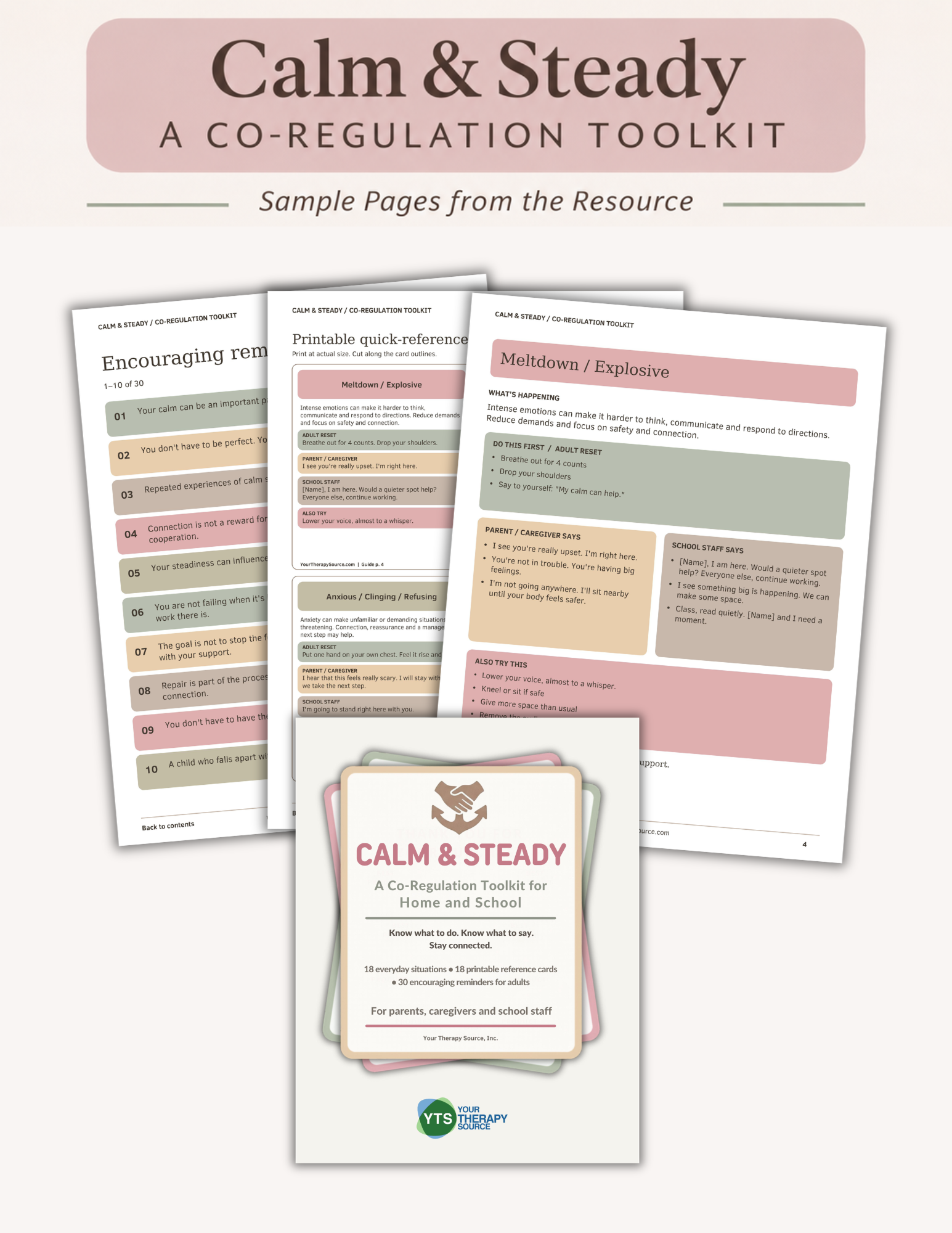
The Calm and Steady: A Co-Regulation Toolkit provides practical support for adults navigating emotionally challenging situations at home and school.
The toolkit includes:
- Adult reset strategies to help you manage your own emotional responses.
- Suggested scripts for school staff, parents, and caregivers.
- Explanations of what may be happening when children experience emotional dysregulation.
- Practical actions and environmental modifications.
- Printable quick-reference cards.
- Encouraging reminders for adults.
Keep these resources on your desk, in your therapy room, or on your digital device for easy access. Share them with your educational team to encourage consistent, supportive responses throughout the school day.
ADULTS NEED REGULATION SUPPORT, TOO
We spend considerable time teaching students how to recognize their emotions, manage frustration, and respond to challenging situations. Adults deserve opportunities to develop and practice these skills within a supportive school environment, too.
Emotional regulation should not become another item on an already overwhelming list of expectations for educators. Instead, it can be viewed as a set of tools that may help make difficult moments more manageable, support our emotional well-being, and strengthen our relationships with students.
Some days will be more challenging than others. The goal is not perfection but supporting the well-being of both students and the adults who work with them.
REFERENCE
Stark, K., & Stoffers, M. (2026). The role of teachers’ own emotional regulation in behavior management: Implications for teacher well-being and burnout. Beyond Behavior, 35(2), 94–103. https://doi.org/10.1177/10742956261449677
DOWNLOAD YOUR FREE ADULT EMOTIONAL REGULATION REFERENCE SHEET
The free Before I Respond: 3 Steps for Adult Emotional Regulation printable provides a quick reference for the three steps discussed in the research article:
- Identify your own emotions.
- Reappraise the situation.
- Adjust how you express your emotions.
Each section includes reflective questions and compassionate reminders to support adults during challenging moments. These are tools to help you, not expectations to be perfect. Keep a copy on your desk, in your therapy room, or in the staff room. Share it with teachers, paraprofessionals, and other school staff as a reminder that their emotional well-being matters, too. Enter your email address below to download your free printable.