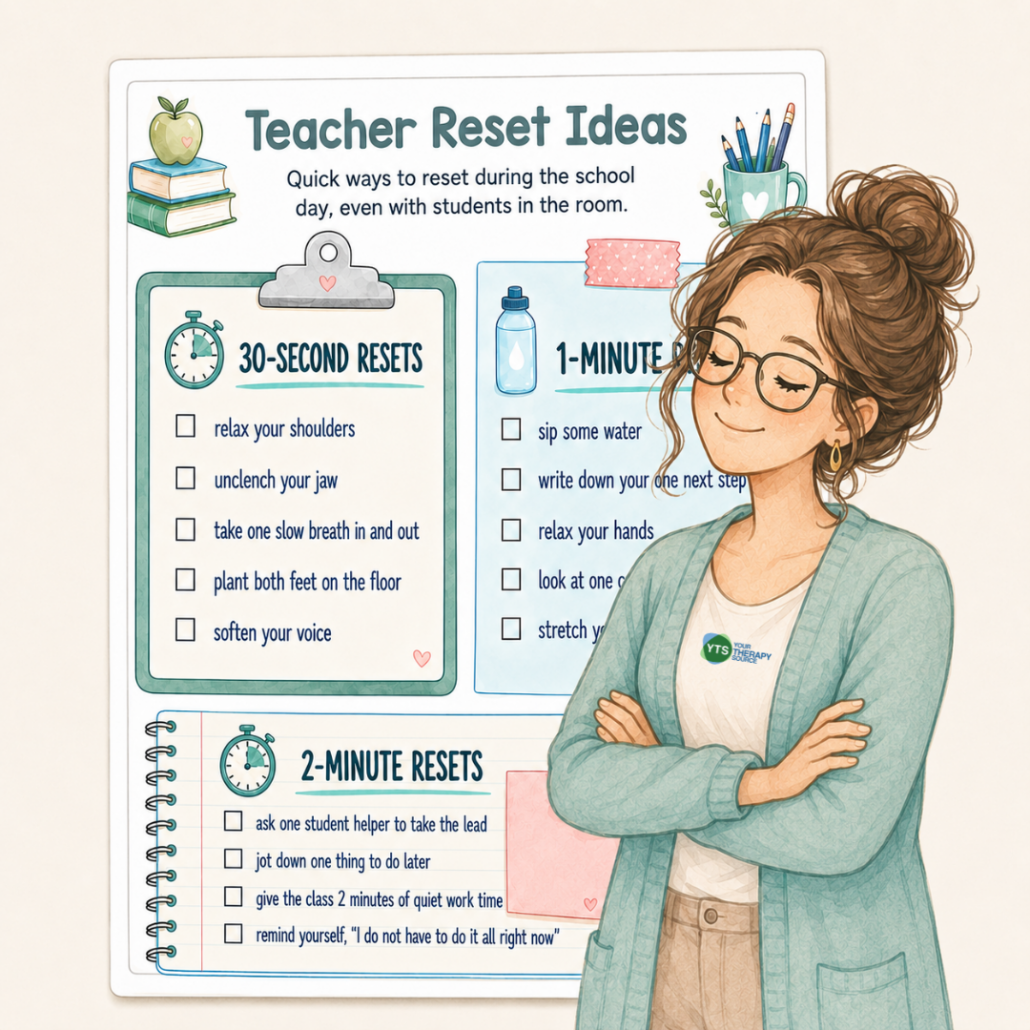
Preventing Teacher Burnout Free Printable
Teaching requires an incredible amount of attention, decision-making, emotional regulation, flexibility, and problem solving. Teachers are expected to support students, manage the classroom, deliver instruction, respond to unexpected needs, communicate with families, document progress, and keep moving through the school day. That is a lot for one nervous system. Explore this free printable preventing teacher burnout PDF to support you this school year.
When we support students, we often talk about preventing meltdowns before they happen. We look for early signs, reduce demands when possible, provide movement, change the environment, and teach strategies before a student is completely overwhelmed. Teachers deserve the same proactive approach.
Preventing teacher burnout cannot only mean taking care of yourself after school, over the weekend, or during summer break. Sometimes it means finding tiny opportunities during the actual school day to reset your body, reduce the mental load, and stop carrying every responsibility yourself.
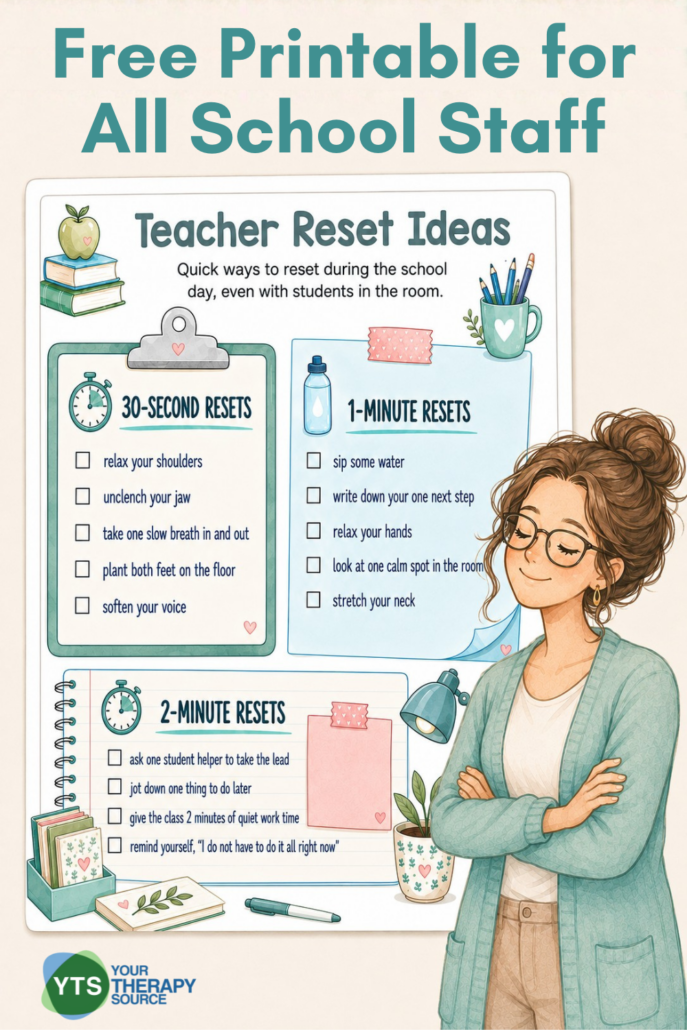
You can download the FREE Teacher Reset Ideas printable at the bottom of this post. The printable includes quick 30-second, 1-minute, and 2-minute reset ideas that can realistically be used while students are still in the classroom.
Preventing Teacher Burnout Starts Before You Are Completely Exhausted
Burnout usually does not appear out of nowhere. There may be small signs throughout the day:
- your shoulders are creeping toward your ears
- your jaw is clenched
- you are rushing from one thing to another
- every interruption feels harder to tolerate
- your voice is getting louder
- you cannot decide what to do next
- you feel as though every student needs something from you at the same time
- you are mentally carrying ten unfinished tasks
None of these mean that you are doing a poor job. They may simply be signs that your brain and body need a reset. Waiting until you are completely depleted makes recovery much harder. Small resets throughout the day may help interrupt that buildup.
Use the Same Proactive Thinking We Use With Students
Teachers regularly anticipate student needs. We might notice that a student does better when directions are visual, when movement is built into the day, when a task is broken into smaller pieces, or when sensory demands are reduced. The same principle applies to adults. Instead of thinking:
“I just have to push through until dismissal.”
Try thinking:
“What would make the next five minutes slightly easier?”
It does not have to be a major intervention.
A reset might be:
- dropping your shoulders
- unclenching your jaw
- taking one slower breath
- relaxing your hands
- taking a sip of water
- stretching your neck
- looking at one calm spot in the classroom
- writing down the one thing you need to do next
These actions will not eliminate the demands of teaching, but they can create a brief interruption in the stress response.
A Teacher Reset Has to Be Realistic
Advice for teacher self-care sometimes misses one important detail. There are students in the room. You cannot always leave the classroom, go for a walk, meditate for twenty minutes, or sit quietly with a cup of tea.
That is why the free Teacher Reset Ideas printable focuses on very short strategies that can happen during the school day. The printable is organized into:
30-Second Resets
These are quick body-based resets such as relaxing your shoulders, unclenching your jaw, taking one slow breath, planting both feet on the floor, or softening your voice.
1-Minute Resets
When you have slightly more time, you might sip some water, identify your one next step, relax your hands, find a calm visual spot in the room, or stretch your neck.
2-Minute Resets
Two minutes can also be an opportunity to reduce what you are carrying mentally. You might jot down something that can wait, allow the class to work quietly for a moment, or remind yourself:
“I do not have to do it all right now.”

Preventing Teacher Burnout Also Means Teachers Cannot Do Everything
This piece is important. Teacher burnout is not going to be solved by asking teachers to become better at tolerating impossible workloads. Sometimes the reset needs to be:
Stop doing something for students that they can begin doing for themselves. Sometimes teachers can become the classroom’s constant:
- reminder
- problem solver
- organizer
- direction giver
- corrector
- prompter
- materials finder
- transition manager
Over time, that is exhausting for the teacher and it may unintentionally limit opportunities for students to develop independence. Students need support, but support does not always mean an adult doing more. Sometimes it means helping students learn what to notice, what strategy to choose, and what to do next.
Student Independence Can Be Part of Preventing Teacher Burnout
Imagine the difference between a classroom where the teacher repeatedly says:
“Get your pencil.”
“Look at the board.”
“What are you supposed to be doing?”
“Keep going.”
“Check your work.”
“Put that away.”
“Get ready for the next activity.”
Now imagine students gradually learning to recognize:
- what helps them get ready to learn
- when their body needs movement
- what distracts them
- how they remember directions
- what helps them start a task
- which strategies help them refocus
- when they need help
- what they can try independently first
The goal is not to remove teacher support. The goal is to make teacher support more strategic and less constant. That is better for students and better for teachers.
Discover How I Learn Helps Build Student Independence
This is one of the reasons the Discover How I Learn tool was added to the YTS Action Toolkit. Instead of only looking at a behavior and asking how an adult can correct it, the tool helps explore the brain-body connections that may be influencing learning.
It looks at areas such as sensory processing, self-regulation, attention, executive function skills, and the strategies that may help an individual student participate more successfully.
The framework moves through:
Get Ready → Build Skills → Foster Independence
The long-term goal is not a classroom where the teacher becomes better at prompting students all day. The goal is a classroom where students gradually understand themselves well enough to use strategies, solve more problems, and require less adult prompting over time.
That matters when we talk about preventing teacher burnout. Every routine a student can eventually manage, every strategy a student learns to choose, and every next step a student can identify without waiting for an adult reduces some of the constant cognitive and emotional load placed on the teacher.
Small Resets Are Not the Entire Solution
Teacher burnout is a much larger issue than breathing exercises, water bottles, or stretching. Workload, staffing, student needs, planning demands, paperwork, behavior support, schedules, and inadequate resources all matter. A printable cannot fix those systemic problems.
But teachers still deserve practical tools they can use today.
Thirty seconds of releasing physical tension matters.
One minute of slowing down matters.
Two minutes of not being responsible for absolutely everything matters.
And helping students become increasingly independent matters too.
Download the Free Teacher Reset Ideas Printable
Keep the printable somewhere visible in your classroom, planner, desk area, or staff room. You do not need to complete every strategy. Use it as a reminder that when you notice yourself becoming overloaded, you are allowed to make the next few minutes easier.
Preventing teacher burnout is not about asking teachers to become more resilient to endless demands. It is about noticing the load earlier, finding small ways to reduce it, and helping students develop the independence that allows teachers to step out of the role of constant corrector.
Download the FREE Teacher Reset Ideas printable below and check out the Discover How I Learn tool to explore another way to support students while working toward greater student independence.