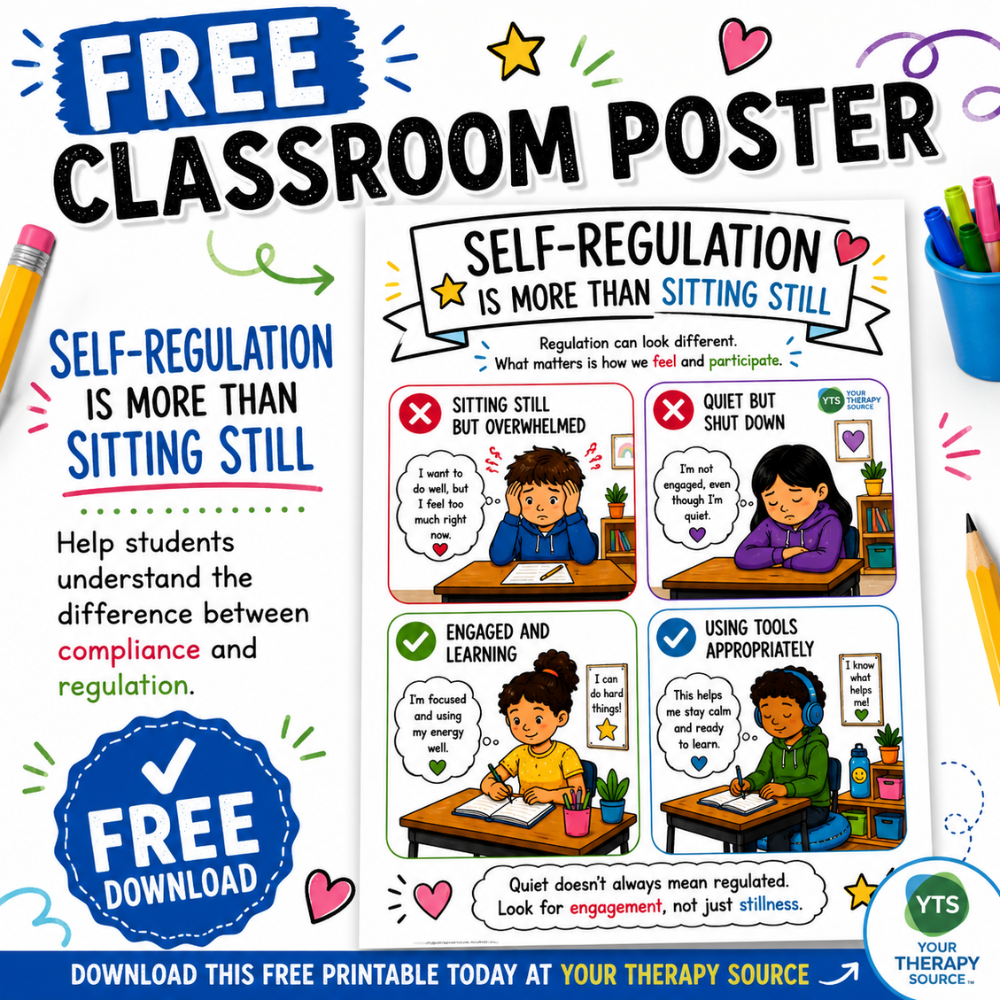
Self-Regulation Is More Than Just Sitting Still Free Printable
Many students who appear calm and compliant are not actually regulated, while some students who fidget or move are doing exactly what their bodies need. This free printable poster helps teachers, therapists, and parents reframe what self-regulation truly looks like in a classroom setting. Download this Self Regulation is More Than Just Sitting Still FREE poster at the bottom of this post. This freebie is from the complete Visual Posters to Support Self Regulation Packet.
What’s Included in This Self-Regulation Printable
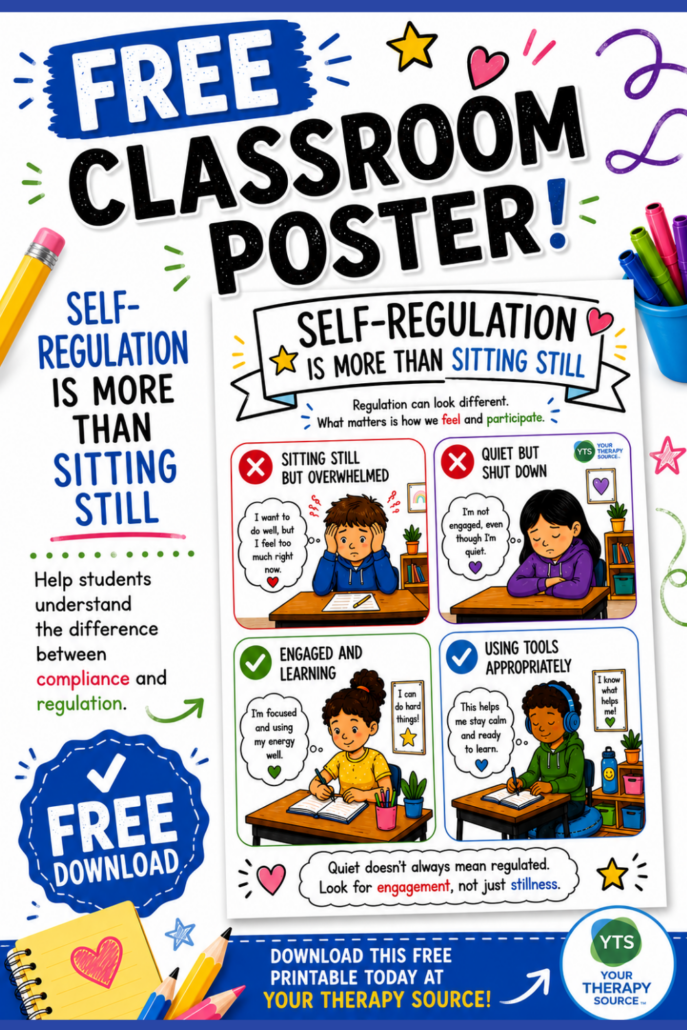
This single-page poster uses four illustrated scenarios to show the difference between appearing regulated and actually being regulated.
- A “Sitting Still But Overwhelmed” panel shows a child at a desk with the thought bubble, “I want to do well, but I feel too much right now,” marked with a red X to indicate this is not true regulation.
- A “Quiet But Shut Down” panel shows a child who is silent and withdrawn, thinking, “I’m not engaged, even though I’m quiet,” also marked as not regulated.
- An “Engaged and Learning” panel shows a child actively writing and thinking, “I’m focused and using my energy well,” marked with a green checkmark as a positive example of regulation.
- A “Using Tools Appropriately” panel shows a child wearing headphones and thinking, “This helps me stay calm and ready to learn,” also marked as a healthy, regulated state.
- A bold footer message at the bottom of the poster reads: “Quiet doesn’t always mean regulated. Look for engagement, not just stillness.”
Skills This Self-Regulation Poster Supports
This printable directly addresses the following skills and concepts:
- Self-regulation and emotional regulation
- Interoception and body awareness
- Focus and attention
- Self-advocacy and use of regulation tools
- Sensory processing awareness
- Understanding pathological demand avoidance and varied presentations of dysregulation
When students understand that regulation is about engagement and participation, not just stillness, they are better equipped to identify their own needs and ask for support. This awareness is foundational to building lasting self-advocacy skills that transfer across school, home, and community settings.
Quiet Doesn’t Always Mean Regulated
One of the most common misconceptions in classrooms is that a quiet student is a regulated student. A child can be completely still and silent while internally flooded with anxiety, overwhelmed by sensory input, or emotionally shut down. Quiet compliance without genuine engagement is not a sign that a student is ready to learn.
This matters because students who present as quiet and easy to manage are sometimes the ones whose needs go unnoticed the longest. A child who shuts down rather than acts out rarely triggers concern, yet that shutdown state is its own form of dysregulation. Interoception, the ability to sense what is happening inside the body, plays an important role here. Students who struggle with interoceptive awareness may not even be able to identify that they are overwhelmed until the feeling becomes unmanageable.
It is also worth noting that stillness can look very different depending on the student. For some children, particularly those with pathological demand avoidance profiles, quiet withdrawal is a coping response to feeling unsafe or out of control in the environment. Recognizing the difference between genuine calm and a shutdown state allows educators and therapists to respond with the right kind of support rather than simply moving on because the room is quiet.
Look for Engagement, Not Just Stillness
If quiet does not always mean regulated, the more useful question becomes: what does a regulated student actually look like? Engagement is a far more reliable indicator than stillness. A regulated student is one who is participating in the task at hand, even if they are moving, fidgeting, or using a tool to help their body stay calm.
Engagement can look many different ways depending on the child and the setting:
- Orienting toward the speaker or task
- Actively writing, drawing, building, or responding to prompts
- Using a regulation tool, such as headphones, a fidget, or a wobble seat, while staying connected to the activity
- Asking questions or contributing to a discussion
- Showing effort and persistence, even when the task is hard
- Moving their body purposefully, such as rocking or shifting, while still tracking what is happening in the room
Self-regulation and emotional regulation are not about achieving a perfect, motionless state. They are about a student’s ability to manage their internal experience well enough to participate. When adults shift their focus from “is this child sitting still?” to “is this child engaged?”, it opens the door to more accurate observations, more effective support, and a more inclusive classroom environment for every learner.
How to Use This Self-Regulation Poster Activity
This printable works in a variety of settings:
- Occupational therapy sessions: Use as a discussion starter to help students identify which panel reflects how they feel during different parts of the day.
- Classroom instruction: Display as an anchor chart during SEL lessons or morning meetings to build shared vocabulary around regulation.
- Staff professional development: Share with teachers and school staff to help shift expectations away from quiet compliance toward genuine engagement.
- Parent education: Send home as a handout to help families understand what regulated participation looks like beyond sitting still.
Tips and Variations
For younger children or students new to regulation language, walk through each panel together before expecting independent reflection. Ask simple questions like, “Which one looks like you right now?” to build awareness without pressure.
For older students or those with more developed self-awareness, pair this poster with a brief check-in routine. Students can point to or name which panel matches their current state at the start of a session or class period, making it a quick and low-prep formative tool.
Laminate the poster and post it in a calm-down corner, therapy room, or classroom sensory station as a permanent visual reference. Pairing it with the self-regulation song creates a multi-sensory routine that reinforces these concepts through movement and music.
You Might Also Like
- Self-Regulation and Emotional Regulation: What School Staff Need to Know
- Interoception Activities
- Pathological Demand Avoidance in Students
- Self-Regulation Song
- The Connection Between Sensory Processing and Self-Regulation
- Self-Regulation in the Classroom
- Sensory Friendly Classroom Ideas Free Printable Handout
Download the Self-Regulation Is More Than Just Sitting Still Free Printable
Self-Regulation Is More Than Just Sitting Still is a free PDF you can print and post in therapy rooms, classrooms, or send home with families right away. This low-prep visual supports meaningful conversations about what regulated participation actually looks like. Enter your email below to download the free printable.