Wakeful Rest: How Can Quiet Thinking Time Help Your Students?
Students move through an enormous amount of information during the school day. A lesson ends, and almost immediately there is another question to answer, another worksheet to complete, another conversation to have, or another activity to begin. But what happens when we occasionally stop adding more information? Research on wakeful rest suggests that periods with reduced cognitive demands after learning may support the consolidation of recently learned information (Wamsley, 2022).
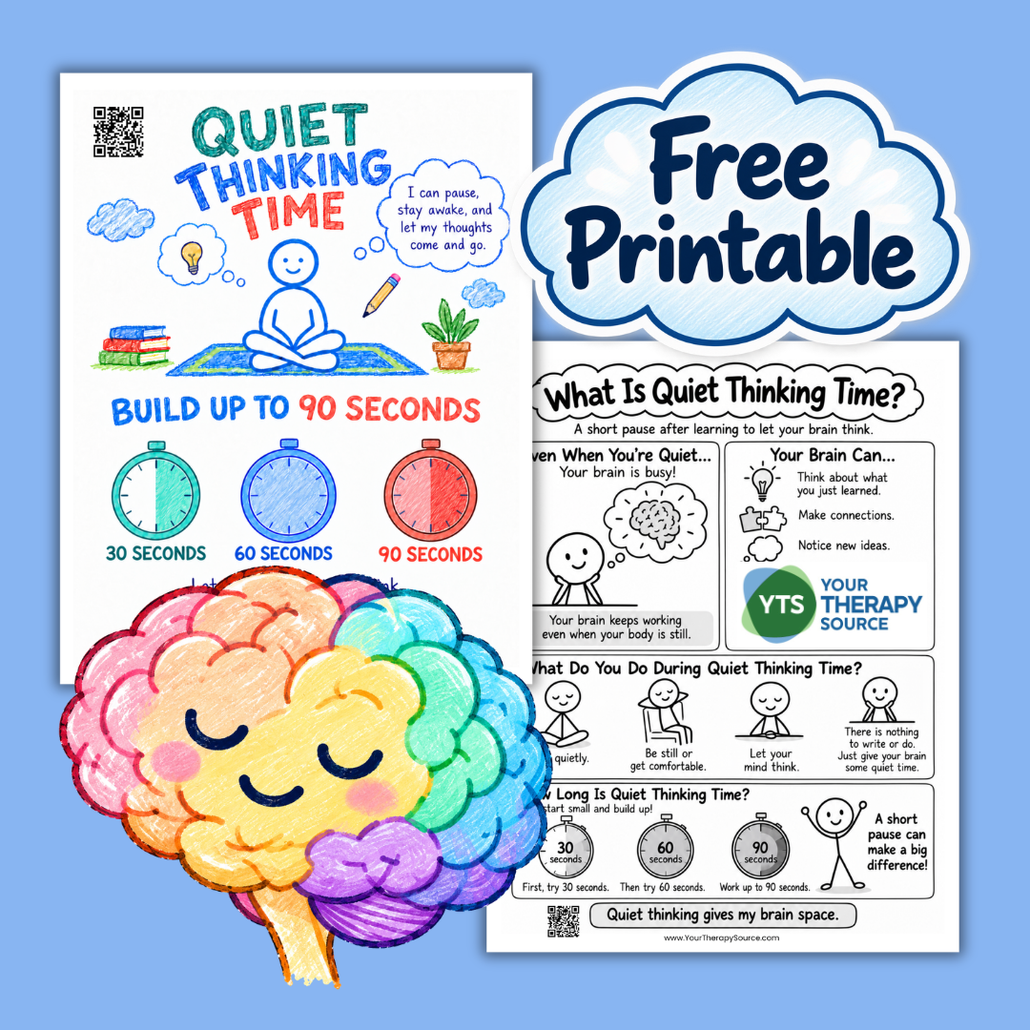
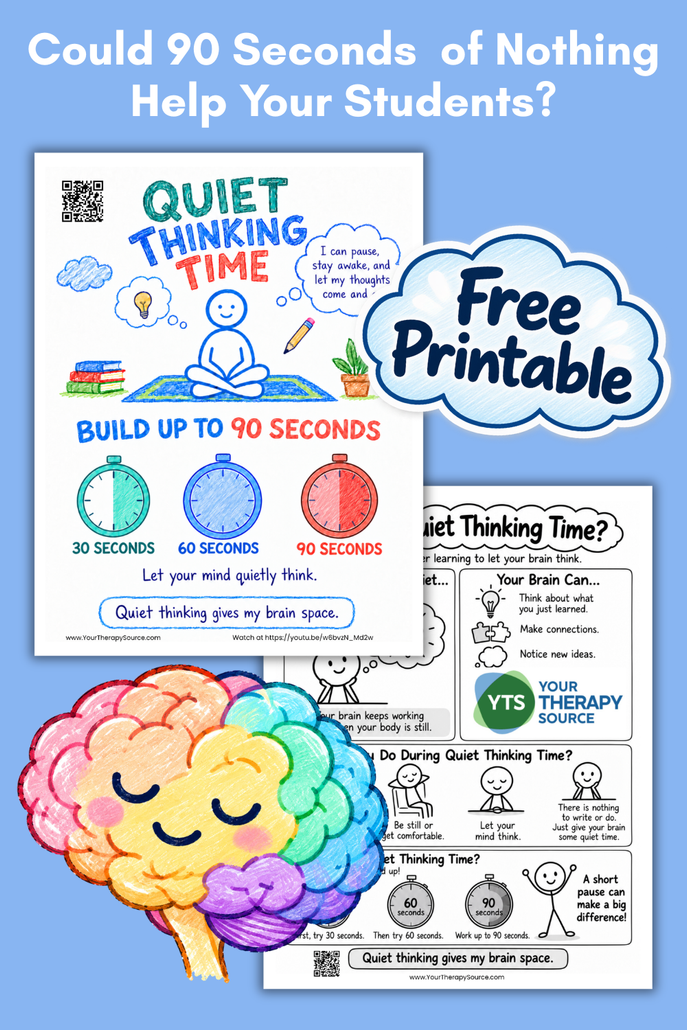
Quiet Thinking Time is a simple classroom routine inspired by this idea. Students pause after learning, stay awake, and allow their minds to quietly think before moving on to the next activity. The free Quiet Thinking Time PDF at the bottom of this post helps teachers introduce the routine and gradually build from 30 to 60 to 90 seconds. It also includes a QR code that takes you directly to the free Quiet Thinking Time video.
What Is Wakeful Rest?
Wakeful rest refers to periods when a person is awake but is not actively engaged in another demanding task. Instead of immediately processing additional external information, there is a period with fewer demands and less interference.
Research suggests that offline waking rest following learning can facilitate the consolidation of newly formed memories. Memory reactivation during rest is one potential mechanism researchers are investigating to explain this effect (Wamsley, 2022).
Interestingly, researchers are also investigating very short periods of rest. A major review discusses evidence that seconds-long periods of offline rest occur naturally throughout the day and that these very short periods might benefit memory, although considerably more research is needed (Wamsley, 2022).
What Does the Research Say About Wakeful Rest in the Classroom?
Most research on wakeful rest has not examined a 30- to 90-second routine in a typical classroom. However, a 2026 study brings this research directly into an educational setting with children. Researchers studied 10- to 12-year-old children who learned two lists of age-appropriate words. Each learning experience was followed by immediate recall, a 10-minute delay condition, and delayed recall.
The researchers found significantly better word retention following quiet rest, but there was an important limitation. The benefit was observed only when the rest condition occurred first in the experimental procedure, suggesting that the order of conditions influenced the results. The authors concluded that incorporating rest periods into school routines may offer a simple, low-cost approach worth further investigation. They also emphasized that more research is necessary to determine how to optimize these effects in actual classroom settings (Knowles & Craig, 2026).
This distinction is important when applying the research to Quiet Thinking Time. The study used a 10-minute rest period and a specific word-learning task, so it does not demonstrate that 30, 60, or 90 seconds of Quiet Thinking Time will improve students’ memory.
Why Might Wakeful Rest Matter for Students?
Consider how little true downtime many children experience during a typical day. School, homework, conversations, extracurricular activities, television, video games, phones, and other screens can create an almost continuous stream of information.
Even small periods that once contained very little stimulation can quickly be filled with something else. Waiting in line, riding in the car, or having a few free minutes can become another opportunity for the brain to receive new input.
The classroom can follow a similar pattern. Students learn something, answer questions about it, complete an activity, and quickly transition to the next learning experience. Quiet Thinking Time creates a small amount of intentional space within that pattern. Instead of immediately adding something else, students are briefly given permission to simply think.
What Does the Default Mode Network Have to Do With Wakeful Rest?
The brain does not simply turn off when a student stops actively completing a task. One network that is particularly interesting when discussing internally directed thinking is the default mode network, often abbreviated as the DMN.
Research associates the DMN with self-reference, social cognition, episodic and autobiographical memory, language and semantic memory, and mind wandering. One current model proposes that the DMN helps integrate memory, language, and semantic representations into a coherent internal narrative based on our experiences (Menon, 2023).
More recent research is examining how spontaneous thought during wakeful rest may interact with memory reactivation and consolidation. Researchers have proposed that DMN activity associated with spontaneous thought may provide a neural context that supports the propagation of reactivated information during memory consolidation (Zhang & Wamsley, 2026).
This is an evolving area of neuroscience, so the default mode network should not be viewed as a simple “learning switch” that automatically turns on whenever a classroom becomes quiet. The student-friendly takeaway is much simpler: a brain that looks quiet from the outside can still be busy on the inside.
What Is Quiet Thinking Time?
Quiet Thinking Time is a short pause after learning when students are not immediately given something else to do. Students stay awake, get comfortable, and allow their thoughts to come and go.
There is no required response at the end of the quiet period. Students do not have to explain what they thought about, remember a specific fact, or demonstrate that they used the time in a particular way. The student printable reinforces this idea by explaining that there is nothing to write or do during Quiet Thinking Time. Students are simply encouraged to give their brains some quiet time.
Why Not Add Reflection Questions?
Reflection questions can be excellent learning tools, but they serve a different purpose. Asking students what they learned, what surprised them, or how new information connects with previous knowledge immediately gives the brain another task.
Quiet Thinking Time intentionally removes that requirement. For a brief period, students are not expected to produce an answer, organize their thoughts for someone else, or demonstrate their learning. Their minds may return to what they just learned, make a connection, notice something new, or wander somewhere completely different. The important distinction is that the adult is not directing what must happen during those few seconds.
Start With 30 Seconds of Quiet Thinking Time
A classroom does not need to begin with 90 seconds of quiet. Start with 30 seconds so students can learn what Quiet Thinking Time feels like and understand the routine. Once 30 seconds becomes familiar, increase the time to 60 seconds. Eventually, students can work toward the complete 90-second Quiet Thinking Time routine included in the free video and printable.
There is no evidence that 90 seconds is a special neurological threshold. The 30 → 60 → 90 second progression is a practical classroom routine, not a research-established prescription.
When Can You Use Wakeful Rest in the Classroom?
One of the easiest times to experiment with Quiet Thinking Time is immediately after students learn something new. Finish the lesson and, instead of immediately asking another question or beginning the next activity, provide a short pause.
This could be used after a math lesson, reading a story, learning new vocabulary, watching an educational video, participating in a class discussion, or practicing a new skill. It does not need to follow every lesson or become another rigid requirement in the classroom schedule.
The purpose is to begin noticing places where students are receiving information continuously. Some of those transitions may offer an opportunity to intentionally provide less input rather than more.
Get Ready, Build Skills, Foster Independence
Quiet Thinking Time fits naturally into the Get Ready → Build Skills → Foster Independence framework. The routine begins with explicitly teaching students what they are doing rather than suddenly expecting them to sit quietly.
During Get Ready, students learn that being quiet does not mean their brains have stopped working. The free printable provides a student-friendly explanation of Quiet Thinking Time and introduces the idea that the brain can continue thinking while the body is still.
During Build Skills, students practice the routine beginning with 30 seconds and gradually increasing the duration. The Quiet Thinking Time video provides a predictable visual timer so students can see time passing without needing to watch a numerical countdown.
During Foster Independence, the larger goal is for students to become increasingly aware of the conditions and strategies that support their own learning. Read 50 Student Success Strategies to Foster Independence for additional ideas to help students gradually take greater ownership of their learning.
Quiet Thinking Time and Self-Regulation
Although Quiet Thinking Time is being introduced here through the lens of wakeful rest and learning, the routine also provides an opportunity to practice self-awareness. Students experience what it feels like to pause without immediately responding to another external demand.
They may notice thoughts, feelings, confusion, or new ideas during that time. They do not need to analyze those experiences or report them to the adult supporting the activity.
Developing awareness of internal experiences can be an important component of self-regulation. The free Body Awareness Worksheet provides another activity for helping students notice information coming from their bodies.
Students can also differ considerably in how they experience sensory information in their environments. Learn more about sensory responses and classroom support in Sensory Over-Responsivity in Kids – Research and Free Printable.
What If Students Have Difficulty With Quiet Thinking Time?
Thirty seconds of doing nothing may initially feel surprisingly long to students who are accustomed to continuous activity and stimulation. Some students may look around, fidget, change positions, or have difficulty remaining quiet.
That does not mean the routine has failed. Quiet Thinking Time is something students are learning, which is exactly why the progression begins with only 30 seconds.
Students do not have to close their eyes, sit perfectly still, or use a particular body position. This is wakeful rest, not a meditation exercise, and students can be comfortable while remaining awake and allowing their minds time to think.
Quiet Thinking Time Gives Teachers a Pause Too
Students are not the only people in the classroom moving rapidly from one demand to another. Teachers are constantly explaining, observing, answering questions, preparing materials, managing transitions, and deciding what needs to happen next.
When students have 30, 60, or 90 seconds of Quiet Thinking Time, the teacher gets that pause too. For a brief period, no one has to immediately produce, answer, explain, or transition. That shared pause may become a valuable part of the classroom routine. Sometimes creating a better learning environment is not about adding another strategy, but intentionally leaving a little space between the strategies already being used.
References
Knowles, B. P., & Craig, M. (2026). Quiet rest in the classroom: Evidence for superior wordlist memory in 10–12-year-old children when new learning is followed by a brief period of quiescence. Applied Cognitive Psychology, 40(4), e70252. https://doi.org/10.1002/acp.70252
Menon, V. (2023). 20 years of the default mode network: A review and synthesis. Neuron, 111(16), 2469–2487. https://doi.org/10.1016/j.neuron.2023.04.023
Wamsley, E. J. (2022). Offline memory consolidation during waking rest. Nature Reviews Psychology, 1, 441–453. https://doi.org/10.1038/s44159-022-00072-w
Zhang, M., & Wamsley, E. J. (2026). The default mode network: Where spontaneous thought meets memory consolidation. Current Opinion in Behavioral Sciences, 67, 101622. https://doi.org/10.1016/j.cobeha.2025.101622
Download the Free Quiet Thinking Time PDF
The free QuietThinking Time PDF includes two student-friendly pages to help introduce and practice the routine. Students learn what Quiet Thinking Time is, what they can do during it, and how to gradually build from 30 seconds to 60 seconds to 90 seconds.
The PDF also includes a QR code that takes you directly to the free Quiet Thinking Time video. Teachers, related service providers, and parents can use the printable and video together to introduce and support the routine. Quiet Thinking Time offers a simple idea for a school day that can be filled with constant input. After students learn something, occasionally give their brains a little space before asking them to process something new.